
3PL Billing Audit: How to Spot Overcharges and Hidden Fees

Michael DeSarno
8 min read
Cost & Pricing
Share
KEY TAKEAWAYS
• 3PL billing errors typically inflate fulfillment costs 20% to 30% above projected rates, with dimensional weight overcharges being the most common culprit.
• Run a 7-step billing audit quarterly: gather docs, map line items to rate card, reconcile order volume, audit shipping, review storage, flag miscellaneous charges, request credits.
• Red flags include cost-per-order increases over 10%, unmatched invoice line items, and 3PLs that resist sharing detailed billing breakdowns.
• Prevent recurring errors with monthly reconciliation, quarterly rate card reviews, and real-time dashboard access from your 3PL.
Last Updated:
Here is a scenario that plays out more often than most brands realize. You signed with a 3PL, agreed on a rate card, and started shipping orders. Six months later, your fulfillment costs are 20% to 30% higher than projected, and you cannot figure out why. The per-order rate looks the same on paper. The volume is tracking to plan. But somewhere between the rate card and the actual invoice, money is disappearing.
Welcome to the world of 3PL billing complexity. It is not always malicious. Sometimes it is sloppy systems, outdated rate tables, or poorly defined contracts. But the result is the same: your margins shrink while your 3PL's don't.
A proper 3PL billing audit is the single most effective way to reclaim lost margin without changing a single thing about your product, marketing, or pricing strategy. This guide walks you through exactly how to do it.
Why 3PL Invoices Are So Hard to Verify
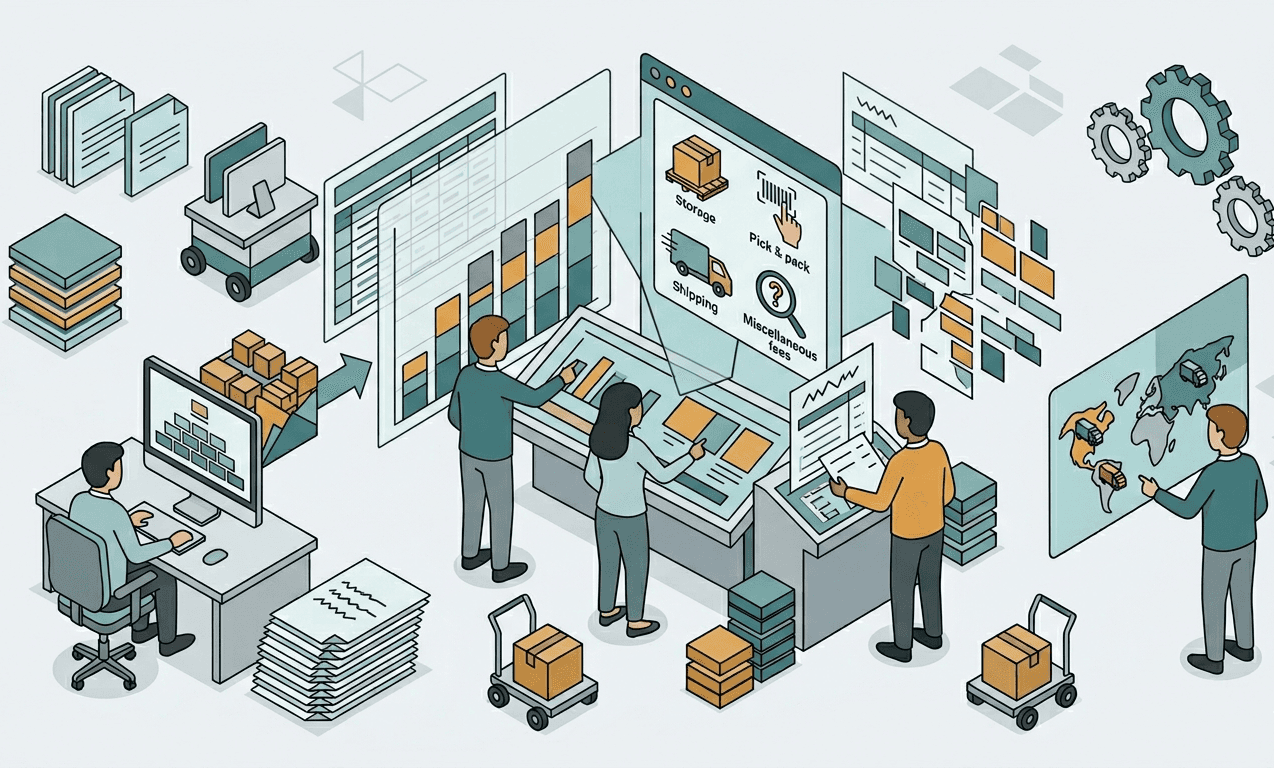
Fulfillment billing is inherently complex. Unlike a SaaS subscription where you pay one flat fee, 3PL invoices can include dozens of line items spanning storage, pick and pack, materials, shipping, special handling, and more. Each line item has its own unit of measure (per pallet, per unit, per cubic foot, per order), and many fees are variable based on volume, seasonality, or SKU characteristics.
This complexity creates natural opportunities for billing errors. Some common reasons invoices drift from expectations include dimensional weight recalculations by carriers, storage rate changes that were buried in contract fine print, minimum order fees that apply during slow months, and surcharges for services you assumed were included.
The brands that get burned hardest are the ones growing fastest. When order volume doubles, nobody has time to audit invoices line by line. The finance team pays the bill, assumes it is roughly correct, and moves on. That assumption can cost you tens of thousands of dollars per quarter.
The Most Common Fulfillment Billing Errors
After talking with hundreds of brands evaluating their [fulfillment pricing models](https://shipdudes.com/blog/fulfillment-pricing-models-comparison-finding-the-right-3pl-cost-structure), patterns emerge. Here are the most frequent warehouse billing mistakes we see:
1. Dimensional Weight Overcharges
Carriers bill based on whichever is greater: actual weight or dimensional weight. If your 3PL is not optimizing box sizes or is using oversized packaging, you are paying for air. This is one of the biggest areas where a [shipping cost optimization](https://shipdudes.com/blog/shipping-cost-optimization) strategy pays for itself immediately.
2. Storage Fee Creep
Many 3PLs quote attractive storage rates upfront, then increase them after 30, 60, or 90 days. If you have slow-moving SKUs sitting in the warehouse, those long-term storage surcharges can quietly double your warehousing costs. Good [inventory management for DTC brands](https://shipdudes.com/blog/inventory-management-for-dtc-brands) includes monitoring these charges proactively.
3. Receiving and Inbound Handling Surprises
Your rate card might say receiving is included or charged per pallet. But what happens when a shipment arrives with mixed SKUs on a single pallet? Or when labeling is required? Many 3PLs charge additional fees for inbound processing that were never clearly communicated. Understanding the [warehouse receiving process](https://shipdudes.com/blog/warehouse-receiving-process) helps you anticipate these costs.
4. Pick and Pack Fee Inflation
The per-pick fee is straightforward in theory. But watch for charges like "additional pick" fees that apply after the first item, special handling for fragile or oversized SKUs, and insert or marketing material fees that show up as separate line items. If you want to understand what proper [pick and pack fulfillment](https://shipdudes.com/blog/pick-and-pack-fulfillment) billing looks like, compare your invoices against at least two other providers.
5. Kitting Charges Without Clear Documentation
Brands running subscription boxes or bundled products often face ambiguous kitting fees. Is it per kit? Per component? Per assembly minute? Without clear documentation, these charges become a black box. Transparent [kitting and assembly services](https://shipdudes.com/blog/kitting-and-assembly-services) should come with itemized billing that maps directly to your rate card.
6. Return Processing Markups
Returns are expensive, and some 3PLs treat them as a profit center. Watch for per-return fees that exceed your outbound pick and pack costs, restocking charges, quality inspection fees, and disposal fees. A good [returns management 3PL](https://shipdudes.com/blog/returns-management-3pl) will be upfront about every charge in the returns workflow.
7. Minimum Volume Penalties
Some contracts include monthly order minimums. If you fall below the threshold, you pay the difference. This is especially painful for seasonal brands or those just launching a new channel. Always check your [3PL contract](https://shipdudes.com/blog/3pl-contract-red-flags-12-terms-that-will-cost-you-(and-what-to-negotiate-instead)) for minimum commitments.
How to Run a 3PL Billing Audit: Step by Step
A thorough 3PL invoice review does not require forensic accounting skills. It requires organization, access to the right data, and a systematic approach.
Step 1: Gather Your Documentation
Collect these items before you start:
- Your original rate card or pricing agreement
- The last 3 to 6 months of invoices
- Your order data from Shopify, Amazon, or whatever platform you sell on
- Carrier invoices (if you have access to them separately)
- Your contract, including all amendments and addendums
Step 2: Map Invoice Line Items to Your Rate Card
Create a spreadsheet that lists every line item on your invoice alongside the corresponding rate card entry. Flag anything that does not have a clear match. These unmatched line items are your first area of investigation.
Common findings at this stage include fees for services not listed in your rate card, rates that do not match the agreed pricing, and entirely new charge categories that appeared without notice.
Step 3: Reconcile Order Volume
Pull your order count from your ecommerce platform and compare it against the number of orders billed by your 3PL. They should match. If the 3PL is billing for more orders than you actually shipped, that is an immediate red flag.
Also check for duplicate charges. System glitches can cause the same order to be billed twice, especially during [flash sale fulfillment](https://shipdudes.com/blog/flash-sale-fulfillment-handling-sudden-order-volume-spikes) periods when volume spikes.
Step 4: Audit Shipping Charges
Shipping is typically the largest line item on your fulfillment invoice. Verify that carrier rates match what was quoted, dimensional weight calculations are accurate, zone classifications are correct (a 3PL with [dual-coast warehousing](https://shipdudes.com/blog/fulfillment-centers-east-and-west-coast) should be shipping from the closer warehouse, reducing zone costs), and fuel surcharges align with published carrier rates.
If your 3PL is not leveraging [zone skipping](https://shipdudes.com/blog/zone-skipping-fulfillment-how-smart-3pls-cut-shipping-costs-beyond-dual-coast) or [carrier diversification](https://shipdudes.com/blog/3pl-carrier-diversification-why-single-carrier-strategies-fail-during-peak-season) strategies, you may be overpaying on shipping even if the per-label rate is technically correct.
Step 5: Review Storage Calculations
Storage is billed by pallet position, cubic foot, or bin location depending on your agreement. Verify the unit of measure, count of occupied positions, and whether long-term storage surcharges have been applied. Cross-reference with your [inventory management](https://shipdudes.com/blog/3pl-inventory-management-systems-real-time-visibility-and-control) dashboard to confirm on-hand quantities match what you are being billed for.
Step 6: Check for "Miscellaneous" or Uncategorized Charges
This is where hidden fees love to hide. Vague line items like "account management," "technology fee," "compliance surcharge," or "special project" deserve scrutiny. Every charge should be traceable to a specific service and a specific rate.
Step 7: Document Findings and Request Credits
Once you have identified discrepancies, compile them into a clear document with the invoice date, line item, expected charge, actual charge, and variance. Present this to your 3PL with a request for credits or adjustments. A reputable fulfillment partner will review and correct legitimate errors promptly.
Red Flags That Your 3PL Billing Needs a Deeper Look
Not sure if a full audit is worth the time? Here are warning signs that a 3PL fee analysis is overdue:
- Your cost per order has increased by more than 10% without a clear explanation
- You receive invoices with line items you cannot map to your rate card
- Your 3PL resists sharing detailed billing breakdowns
- Storage charges keep climbing even though your inventory levels are stable
- You are charged for services you did not request (custom packaging, special labeling)
- Your 3PL makes it difficult to export billing data
If any of these sound familiar, it is time to dig in.
How ShipDudes Approaches Billing Transparency
At ShipDudes, we built our billing model to eliminate the ambiguity that makes audits necessary in the first place. As an [omnichannel 3PL](https://shipdudes.com/blog/omnichannel-fulfillment) founded by eCommerce operators, we have been on the brand side of confusing invoices. That experience shaped how we structure pricing.
Every ShipDudes client gets a clear rate card with no hidden categories. Invoices are itemized and reconcilable against real-time dashboard data. Our US-based support team (no overseas call centers) can walk through any invoice line by line. And because we operate our own [dual-coast warehouse network](https://shipdudes.com/blog/nationwide-3pl-fulfillment-why-a-two-coast-setup-beats-a-single-warehouse) in Northern New Jersey and Las Vegas, there is no markup opacity from subcontracted facilities.
Transparency is not a feature we bolt on. It is how we operate. When you are evaluating [how to choose a 3PL](https://shipdudes.com/blog/how-to-choose-a-3pl), billing clarity should be near the top of your checklist.
Preventing Future Billing Issues
An audit is a point-in-time exercise. To prevent billing errors from recurring, build these habits into your operations:
Monthly reconciliation. Do not wait six months. Review invoices monthly against your order data and rate card.
Quarterly rate card review. Confirm that any rate changes were communicated and agreed upon in writing.
Dashboard access. Your 3PL should provide real-time visibility into inventory levels, order counts, and shipping details so you can verify billing inputs independently.
Clear contract language. Ensure your agreement defines every possible charge category, including edge cases like receiving exceptions, rush orders, and [B2B distribution](https://shipdudes.com/blog/b2b-order-fulfillment-edi-integration-and-retail-distribution-essentials) requirements.
Escalation path. Know who to contact at your 3PL when you find a discrepancy. A [US-based fulfillment team](https://shipdudes.com/blog/the-real-cost-of-3pl-overseas-support-why-us-based-teams-matter-for-your-brand) that you can reach during business hours makes resolution dramatically faster.
FAQ
How often should I conduct a 3PL billing audit?
At minimum, perform a detailed 3PL billing audit quarterly. Monthly spot checks on your top five expense categories (shipping, pick and pack, storage, receiving, and returns) will catch most issues before they compound. Brands processing over 5,000 orders per month should review invoices monthly.
What is the most common 3PL billing error?
Dimensional weight overcharges are the single most common fulfillment billing error. When a 3PL uses packaging that is too large for the product, the carrier bills based on the box dimensions rather than actual weight. This can increase shipping costs by 15% to 40% on lightweight items.
Can I get refunds for past 3PL billing mistakes?
Yes. Most 3PL contracts allow you to dispute charges within 30 to 90 days of the invoice date. Document every discrepancy with specific invoice numbers, line items, and expected versus actual charges. Reputable 3PLs will issue credits for verified errors.
What should a transparent 3PL invoice include?
A transparent 3PL invoice should include itemized charges for each service category, the unit of measure and quantity for every line item, carrier name and tracking details for shipping charges, storage calculations with position counts, and a clear total that reconciles with your rate card.
How do I know if my 3PL is overcharging me?
Compare your effective cost per order (total invoice divided by total orders) against your rate card estimate. If the actual cost per order is more than 10% higher than expected, investigate the gap. Also benchmark against industry averages by requesting quotes from other providers.
Stop Guessing, Start Auditing
Every dollar lost to fulfillment billing errors is a dollar that could fund ad spend, product development, or expansion into new channels. A 3PL billing audit is not about being adversarial with your fulfillment partner. It is about running a tight operation and making sure your costs match reality.
If your current 3PL invoices feel like a mystery, or if the thought of auditing them sounds exhausting because the billing is too opaque, that itself is a problem worth solving.
ShipDudes was built by operators who got tired of chasing down unexplained charges. We keep billing simple, transparent, and reconcilable because that is what we would want as brand owners ourselves.
Ready to see what straightforward 3PL pricing actually looks like? [Book a call with ShipDudes](https://shipdudes.com/book-a-call) and we will walk through your current fulfillment costs together.
Ready to Simplify Your Fulfillment?
Let's build a custom pricing model for your brand. No contracts required to start the conversation.