3PL Quality Control Systems: How to Prevent Order Errors Before They Reach Customers

Michael DeSarno
8 min read
Fulfillment Operations
Share
KEY TAKEAWAYS
• 3PL quality control requires barcode verification at five checkpoints: receiving, putaway, picking, packing, and ship-verify.
• A single fulfillment error costs $20 to $50; brands should expect 99.5%+ order accuracy from any 3PL.
• Most order errors originate upstream of pick and pack, often at receiving or inventory slotting.
• ShipDudes enforces scan-driven QC across 75+ integrations with 7-day processing and a US-based team.
Last Updated:
A single wrong item in a shipment costs you more than the price of the product. It costs you the reshipment, the return label, the customer service hours, and most importantly, the customer's trust. For CPG brands scaling across multiple channels, fulfillment center quality control isn't a nice-to-have. It's the difference between a brand that retains customers and one that hemorrhages them.
The frustrating part? Most order errors are completely preventable. They happen because the systems designed to catch them either don't exist or break down at predictable points. If you're evaluating 3PL partners or trying to diagnose why your current error rate is climbing, this post walks through the quality control systems that actually work, and the red flags that signal a warehouse is winging it.
The Real Cost of Fulfillment Errors
Before diving into systems, let's ground this in numbers that matter to your P&L.
Industry data suggests the average cost of a single fulfillment error (wrong item, wrong quantity, wrong address) ranges from $20 to $50 when you factor in return shipping, replacement product, reprocessing labor, and customer service time. That doesn't account for the lifetime value of a customer who decides not to reorder.
For a brand shipping 5,000 orders per month with a 2% error rate, that's 100 mistakes costing $2,000 to $5,000 monthly in direct costs alone. Drop that error rate to 0.5% and you're saving $1,500 to $3,750 every month while sending fewer customers to your competitors.
The brands we work with at ShipDudes typically target order accuracy rates above 99.5%. That number isn't aspirational. It's the baseline for any 3PL that has proper quality control systems in place. Anything below that should prompt serious questions about what's happening on the warehouse floor.
Where Fulfillment Errors Actually Originate
Most brands assume errors happen during the pick and pack process. That's partially true, but the root causes often trace back further in the chain. Understanding where errors originate helps you evaluate whether a 3PL's quality assurance systems cover the full lifecycle.
Receiving and Inbound Processing
Errors that start at the dock door are the hardest to catch later. If inbound inventory isn't counted accurately, if SKUs are mislabeled, or if damaged units get put away without inspection, every downstream process inherits those problems. A solid [warehouse receiving process](https://shipdudes.com/blog/warehouse-receiving-process) includes piece-count verification, SKU matching against purchase orders, and condition inspection before anything touches a shelf.
Inventory Storage and Slotting
Putting the wrong product in the wrong bin location is a silent killer. A picker following their scan gun will grab whatever is in the designated location. If someone stowed Product A in Product B's slot, you now have a systematic error that repeats until someone catches it. This is especially dangerous for brands with similar-looking SKUs (think supplement bottles with different formulations or beauty products in identical packaging).
Pick and Pack
This is where most people focus, and for good reason. The pick and pack stage involves the most human touchpoints. A picker grabs items, a packer verifies and boxes them. Without barcode verification at each step, you're relying on a human to visually confirm every item, every time, across hundreds or thousands of orders per day. That's a recipe for drift.
Shipping and Label Application
The final failure point: the right products in the right box with the wrong label. When a shipping label gets applied to the wrong package, two customers receive incorrect orders simultaneously. It doubles the error impact from a single mistake.
The Quality Control Checkpoints That Actually Work
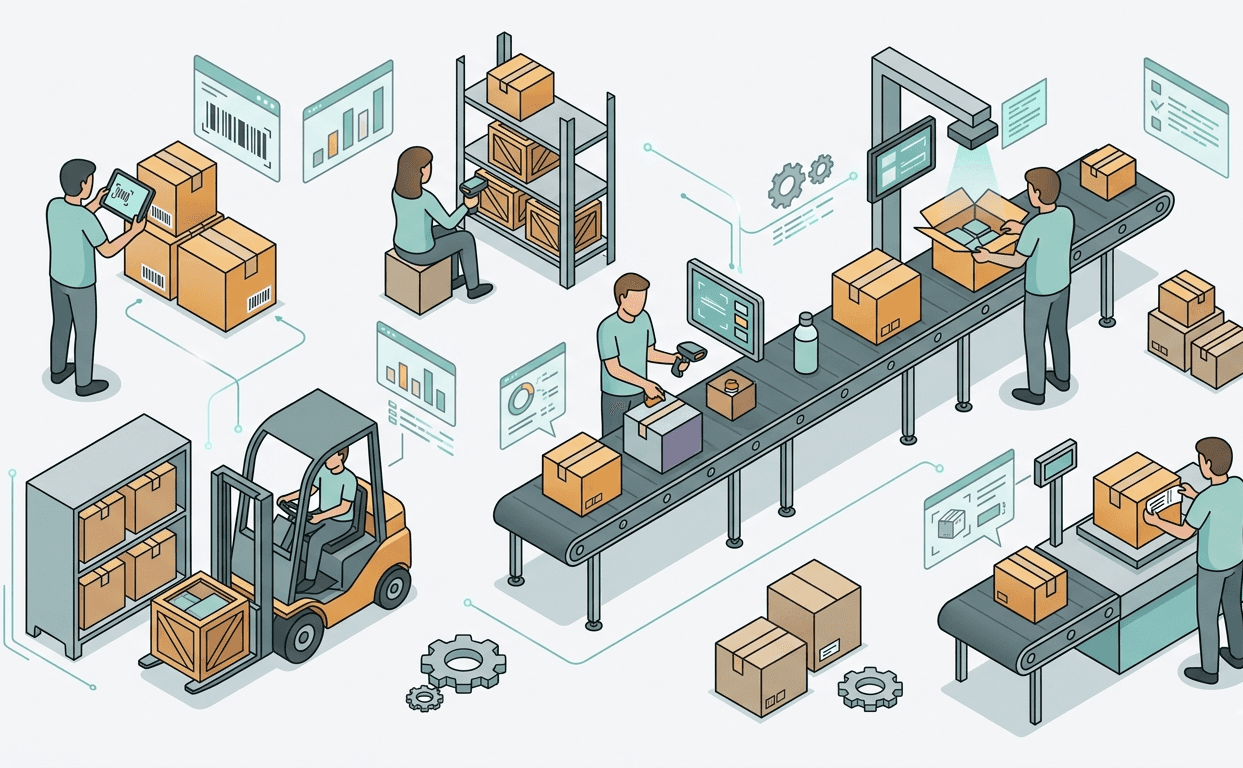
Effective fulfillment center quality control isn't one system. It's a series of checkpoints layered across the entire fulfillment workflow. Here's what to look for when evaluating a 3PL's quality assurance approach.
Checkpoint 1: Barcode-Driven Receiving
Every inbound unit should be scanned against a purchase order or ASN (advance ship notice). The warehouse management system should flag discrepancies in real time: wrong quantities, unexpected SKUs, or missing items. At ShipDudes, this step also includes a condition check for [damaged inventory](https://shipdudes.com/blog/when-fulfillment-goes-wrong-how-to-handle-damaged-inventory-and-shipping-claims) so compromised products never enter pickable inventory.
Checkpoint 2: Location Verification During Putaway
When inventory moves from receiving to storage, the WMS should require a scan of both the product barcode and the bin location barcode. This creates a digital record confirming the right SKU went to the right spot. Any mismatch triggers an alert before the error compounds.
Checkpoint 3: Scan-to-Pick Verification
During the pick process, each item scanned must match what the order requires. If a picker grabs the wrong item, the scan gun rejects it immediately. This is non-negotiable for any fulfillment operation handling more than a few hundred orders per day. Visual-only verification doesn't scale. For a deeper look at how this works in practice, our guide on [pick and pack fulfillment](https://shipdudes.com/blog/pick-and-pack-fulfillment) breaks down the full process.
Checkpoint 4: Pack Station Audit
The pack station is your last line of defense before the order leaves the building. A strong 3PL quality assurance process includes a second scan at the pack station, where items are verified against the order one final time. This is also where packers confirm the correct packaging materials, inserts, marketing collateral, and any special instructions the brand requires.
For brands with [custom packaging and branded fulfillment](https://shipdudes.com/blog/custom-packaging-and-branded-fulfillment-elevate-your-unboxing-experience) requirements, this checkpoint is critical. A perfectly picked order shipped in the wrong box or without the right insert still delivers a poor customer experience.
Checkpoint 5: Ship-Verify Matching
The final scan matches the packed order to the correct shipping label. The system should prevent a label from printing unless it corresponds to the verified contents. This eliminates the crossed-shipment problem where two customers each receive the other's order.
Quality Control for Complex Fulfillment Scenarios
Standard pick-and-pack QC is table stakes. The real test of a 3PL's quality control systems comes when complexity increases.
Kitting and Assembly
When multiple components combine into a single sellable unit, every component must be verified. A [kitting and assembly](https://shipdudes.com/blog/kitting-and-assembly-services) operation needs a bill of materials (BOM) that the WMS enforces at every step. Miss one insert in a bundle and your customer opens a box that feels incomplete.
Subscription Box Fulfillment
Subscription boxes often change month to month, with different product assortments for different subscriber tiers. The QC challenge here is version control, making sure the March box doesn't include February's products and that each tier gets its correct assortment. Brands running [subscription box fulfillment](https://shipdudes.com/blog/subscription-box-fulfillment-complete-guide-for-recurring-revenue-brands) need a 3PL that can manage SKU rotation and BOM changes without manual workarounds.
Lot Tracking and Expiration Management
For supplements, food products, and beverages, fulfillment error prevention includes shipping the correct lot and ensuring FEFO (first expired, first out) rotation. Sending a customer a product that expires next week is functionally the same as sending the wrong item. It destroys trust. Brands in regulated categories like [supplements](https://shipdudes.com/blog/supplement-fulfillment-fda-compliance-lot-tracking-and-expiration-management) or [shelf-stable food](https://shipdudes.com/blog/food-fulfillment-center-requirements-fda-compliance-and-safe-storage) should verify their 3PL tracks lots at the individual unit level, not just the pallet level.
B2B and Retail Distribution
Retail orders carry unique QC requirements. EDI compliance, specific labeling, routing guides, and packing standards that vary by retailer. A single violation can result in chargebacks that dwarf the cost of a wrong DTC shipment. Your 3PL's [B2B fulfillment](https://shipdudes.com/blog/b2b-order-fulfillment-edi-integration-and-retail-distribution-essentials) QC process needs to include retailer-specific validation before any order ships.
How to Evaluate a 3PL's Quality Control Systems
When you're [choosing a 3PL](https://shipdudes.com/blog/how-to-choose-a-3pl), asking "what's your order accuracy rate?" isn't enough. Everyone will say 99%+. Dig deeper with these questions:
Ask for the process, not just the metric. Have them walk you through an order from receiving to ship-out. At which points does the WMS require a scan? Where are human checkpoints? What happens when a scan fails?
Ask about error investigation. When an error does occur, what's the process for root cause analysis? A mature 3PL doesn't just reship, they trace the error back to its origin and fix the systemic issue.
Ask about reporting cadence. Can you see accuracy metrics in real time through a dashboard, or do you have to request reports? Transparency matters here. At ShipDudes, our [3PL inventory management systems](https://shipdudes.com/blog/3pl-inventory-management-systems-real-time-visibility-and-control) give brands real-time visibility into their operations because you shouldn't have to wonder what's happening with your orders.
Ask about team training and accountability. Who's on the warehouse floor? Are they trained, full-time employees or temporary labor that rotates constantly? Having a [US-based fulfillment team](https://shipdudes.com/blog/the-real-cost-of-3pl-overseas-support-why-us-based-teams-matter-for-your-brand) that knows your products and processes is one of the most underrated quality control mechanisms.
Ask about peak season protocols. Quality control often degrades during high-volume periods when temporary staff are brought in and speed takes priority. Understanding a 3PL's [peak season fulfillment strategy](https://shipdudes.com/blog/peak-season-fulfillment-strategy) tells you whether their QC holds up when it matters most.
The Role of Technology in Fulfillment Error Prevention
Modern fulfillment error prevention depends heavily on the WMS and its integrations with your sales channels. When your [multi-channel inventory sync](https://shipdudes.com/blog/multi-channel-inventory-sync-how-to-prevent-overselling-across-shopify-amazon-and-tiktok-shop) is tight, the WMS receives accurate order data from every channel in real time. That means the system knows exactly what needs to go out, and the barcode checkpoints validate against that data at every stage.
ShipDudes integrates with 75+ platforms, from Shopify and Amazon to TikTok Shop and Faire. That level of connectivity means order data flows cleanly into the WMS without manual re-entry, which eliminates an entire category of human-introduced errors before the pick process even begins.
For brands running [omnichannel fulfillment](https://shipdudes.com/blog/omnichannel-fulfillment), this is particularly important. DTC, marketplace, and wholesale orders often have different packaging requirements, shipping rules, and documentation needs. The WMS needs to enforce those differences automatically rather than relying on a packer to remember which channel each order came from.
Building Quality Into Your 3PL Relationship
Quality control isn't something you set and forget. The best results come from brands and their 3PL partners actively collaborating on it. Before you sign, make sure you understand the terms around error accountability. Our guide on [3PL contract negotiation](https://shipdudes.com/blog/3pl-contract-red-flags-12-terms-that-will-cost-you-(and-what-to-negotiate-instead)) covers what to look for in service level agreements.
Once you're live, review accuracy reports monthly. Look for patterns: specific SKUs with higher error rates (often a slotting issue), specific days with more errors (often a staffing issue), or errors concentrated at specific checkpoints (a process issue). A good 3PL partner will welcome this scrutiny because it helps them improve too.
Quality Control Is a System, Not a Promise
Every 3PL promises accuracy. The ones that deliver it have systems you can see, measure, and verify. Barcode-driven workflows at every stage. Real-time inventory visibility. Trained, accountable teams. And a culture that treats every error as a process failure to fix, not a one-off to shrug off.
At ShipDudes, we built our fulfillment operations with these QC principles from day one because our founders lived the pain of working with 3PLs that didn't. With dual-coast warehouses in Northern New Jersey and Las Vegas, [7-day processing](https://shipdudes.com/blog/why-7-day-processing-fulfillment-beats-same-day-promises), and an entirely US-based team, our quality control systems are designed to protect your brand at every touchpoint.
If your current error rate is higher than it should be, or if you're outgrowing a setup where you can personally check every order, it might be time to talk. [Book a call with ShipDudes](https://shipdudes.com/book-a-call) and let's walk through how our fulfillment center quality control systems can keep your customers happy and your return rates low.
Frequently Asked Questions
What is fulfillment center quality control?
Fulfillment center quality control is a set of systems, checkpoints, and processes designed to prevent order errors at every stage of the fulfillment workflow. This includes barcode verification during receiving, putaway, picking, packing, and shipping. The goal is to ensure every customer receives the correct products, in the right quantities, with the right packaging and documentation.
What order accuracy rate should I expect from a 3PL?
A reputable 3PL should maintain an order accuracy rate of 99.5% or higher. This means fewer than 5 errors per 1,000 orders shipped. If your 3PL is consistently below this threshold, their quality control systems likely have gaps that need to be addressed.
How do 3PLs prevent picking errors?
The most effective method is scan-to-pick verification, where each item's barcode is scanned during picking and validated against the order in the warehouse management system. If the wrong item is scanned, the system immediately rejects it and alerts the picker. This replaces error-prone visual verification with technology-enforced accuracy.
What should I ask a 3PL about their quality assurance process?
Ask them to walk you through the full order lifecycle, from receiving to shipment. Identify where barcode scans are required, how errors are investigated and resolved, what reporting and visibility you'll have, and how their process adapts during peak season. A 3PL that can't clearly articulate their QC checkpoints likely doesn't have robust ones.
Does quality control matter differently for B2B versus DTC orders?
Yes. B2B and retail orders often carry retailer-specific requirements, including EDI compliance, routing guides, specific labeling, and packing standards. Errors on B2B orders can result in costly chargebacks from retailers. DTC errors primarily impact customer experience and retention. A strong 3PL has quality control processes tailored to both channels.
Ready to Simplify Your Fulfillment?
Let's build a custom pricing model for your brand. No contracts required to start the conversation.