3PL vs. In-House Fulfillment: The Real Cost Breakdown for Growing DTC Brands

Michael DeSarno
8 min read
Industry Guides
Share
KEY TAKEAWAYS
• Fully loaded in-house fulfillment costs DTC brands $7 to $12 per order versus $3.50 to $8 at a 3PL.
• Negotiated 3PL shipping rates alone save 20 to 40% compared to retail carrier pricing.
• Founder time managing fulfillment (15+ hours/week) is the most underpriced hidden cost.
• The 3PL cost advantage widens significantly once brands cross 1,000 orders per month.
Last Updated:
Why Most Brands Underestimate the True Cost of In-House Fulfillment
Here’s how the 3PL vs. in-house fulfillment comparison usually goes: a founder looks at a 3PL’s per-order fee, compares it to their warehouse rent, and decides outsourcing is too expensive. That math is wrong, not because 3PLs are cheap, but because the in-house number is missing about 60% of the real cost.
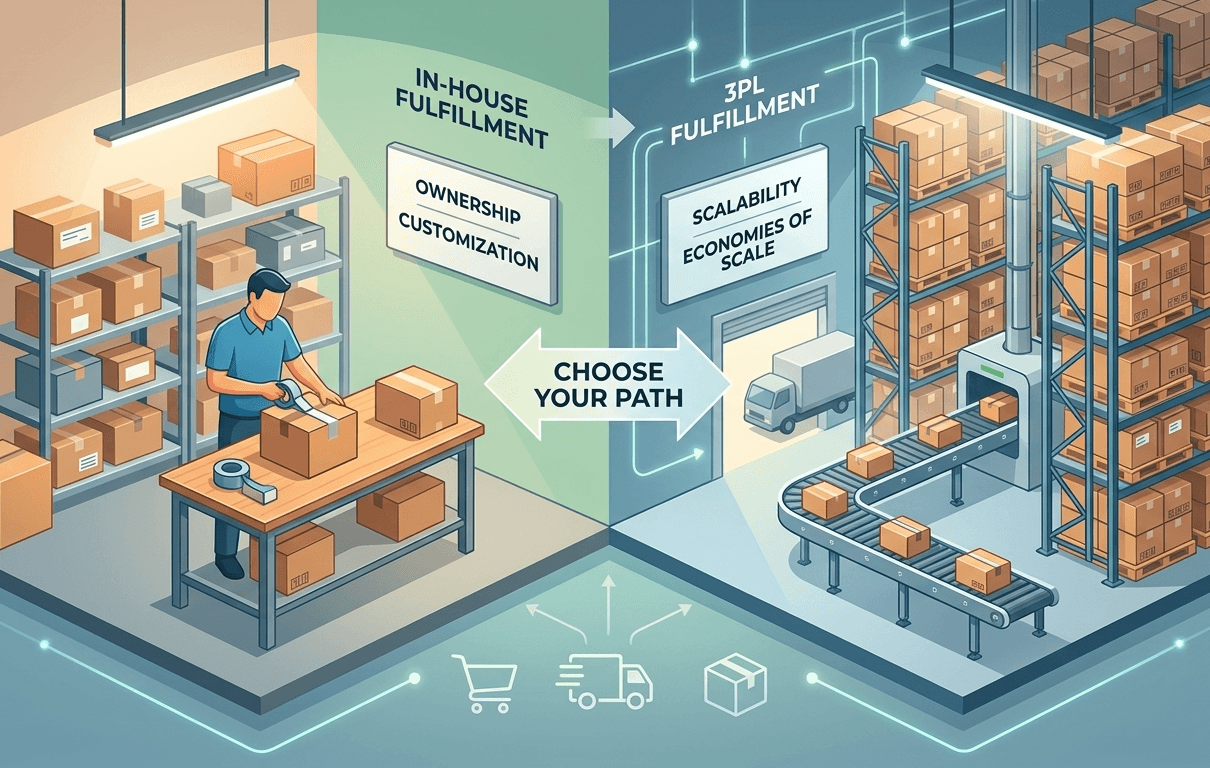
In-house fulfillment has four cost layers most brands only partially account for: space, labor, technology, and error costs. When you stack all four honestly, the per-order economics shift dramatically, and almost always in the 3PL’s favor once you cross a few hundred orders per month.
To make this comparison concrete, we’ll use a realistic scenario: a DTC CPG brand (supplements, personal care, or shelf-stable food) doing 500 orders per month and scaling to 1,500 over twelve months. This is the inflection range where the in-house vs. outsourced decision becomes financially meaningful.
The Real Cost Stack of In-House Fulfillment
Warehouse and space costs. A 1,000–2,500 square foot commercial unit in a mid-tier metro market runs $2,500–$5,000 per month including utilities and insurance. But the real cost isn’t just rent, it’s the dead space you’re paying for during slow months. You lease for peak capacity and eat the cost year-round.
Labor costs. At 500 orders per month, you need at least one to two part-time staff. But hourly wages are just the starting point. Add employer payroll taxes (~7.65%), workers’ comp insurance, hiring and onboarding churn, and, the biggest hidden cost, the founder’s own time managing fulfillment operations instead of growing the business. When you value founder time at even $75/hour, 15 hours per week of fulfillment management costs $4,500 per month in opportunity cost alone.
Technology and supplies. WMS software or Shopify fulfillment apps ($50–$300/month), barcode scanners ($200–$500 each), thermal label printers ($300–$600), packing stations, tape, dunnage, boxes, and carrier account setup. These are both upfront capital expenses and monthly recurring costs that most brands forget to amortize into their per-order calculation.
Shipping rates. This is where in-house operations quietly bleed money. Without volume leverage, you’re paying retail or light-commercial carrier rates. A 3PL passes through negotiated discounts that are typically 20–40% below what you’d pay on your own. On 1,000 shipments per month at an average $10 shipping cost, that gap is $2,000–$4,000 in savings you’re leaving on the table.
Error and rework costs. In-house operations typically run a 1–3% error rate, mispicks, wrong labels, damaged shipments. At 1,000 orders per month with a 2% error rate, that’s 20 orders requiring customer service time, reshipment costs, and replacement product. The direct cost is $15–25 per incident, but the brand damage from late or wrong orders on repeat purchase rates is harder to quantify and far more expensive.
The Real Cost Stack of Outsourcing to a 3PL
Receiving and storage fees. 3PL storage is billed per pallet, per bin, or per cubic foot. For a CPG brand with 2–4 SKUs at the 500–1,500 order per month range, realistic monthly storage costs land in the $300–$800 range. Receiving fees are typically charged per pallet on inbound, plan for $25–50 per pallet.
Pick and pack fees. The core fulfillment charge breaks down as a per-order base fee plus a small per-item pick fee and materials pass-through. For standard CPG products, the all-in fulfillment cost per order, not just the pick fee, but everything from pick to carrier handoff, typically falls in the $3.50–$6.50 range. This is the number to ask 3PLs for directly.
Inbound freight and prep. Don’t forget the cost of getting product to the warehouse: freight from your manufacturer, any kitting or bundle prep fees, and labeling charges if product arrives non-compliant. These costs exist whether you’re in-house or outsourced, but they’re worth budgeting explicitly.
What you’re NOT paying for. This is where the real comparison shifts. With a 3PL, you eliminate the warehouse lease, labor burden, WMS licensing, equipment depreciation, carrier account management, and seasonal staffing headaches entirely. These aren’t just “avoided costs”, they’re fixed expenses that disappear from your P&L and free up cash for inventory, marketing, and product development.
A $5 per-order 3PL fee sounds expensive in isolation. But when your fully-loaded in-house cost at 800 orders per month is $7–$10 per order once you account for everything above, the 3PL isn’t the expensive option, it’s the cheaper one.
Side-by-Side Cost Comparison: The Tipping Point
Here’s how the numbers stack up at three volume levels using our CPG brand scenario:
Monthly Volume | In-House Cost/Order | 3PL Cost/Order |
|---|---|---|
500 order/mo | $8.50-$12.00 | $6.00–$8.00 |
1,000 orders/mo | $7.00–$9.50 | $4.50–$6.50 |
1,500 orders/mo | $6.50–$8.50 | $3.50–$5.50 |
* In-house estimates include fully-loaded costs: rent, labor, technology, supplies, shipping at retail rates, and error/rework. 3PL estimates include storage, pick/pack, and shipping at negotiated rates.
At 500 orders per month, in-house might look comparable if you exclude your own time. But once you factor in founder opportunity cost, the 3PL is already winning. At 1,000 orders and above, the gap widens significantly, primarily driven by negotiated shipping rates and labor efficiency that individual brands simply can’t match.
The question isn’t whether a 3PL costs money. The question is whether running your own warehouse costs you more, and most brands find out the hard way.
The Hidden Costs That Destroy In-House Economics at Scale
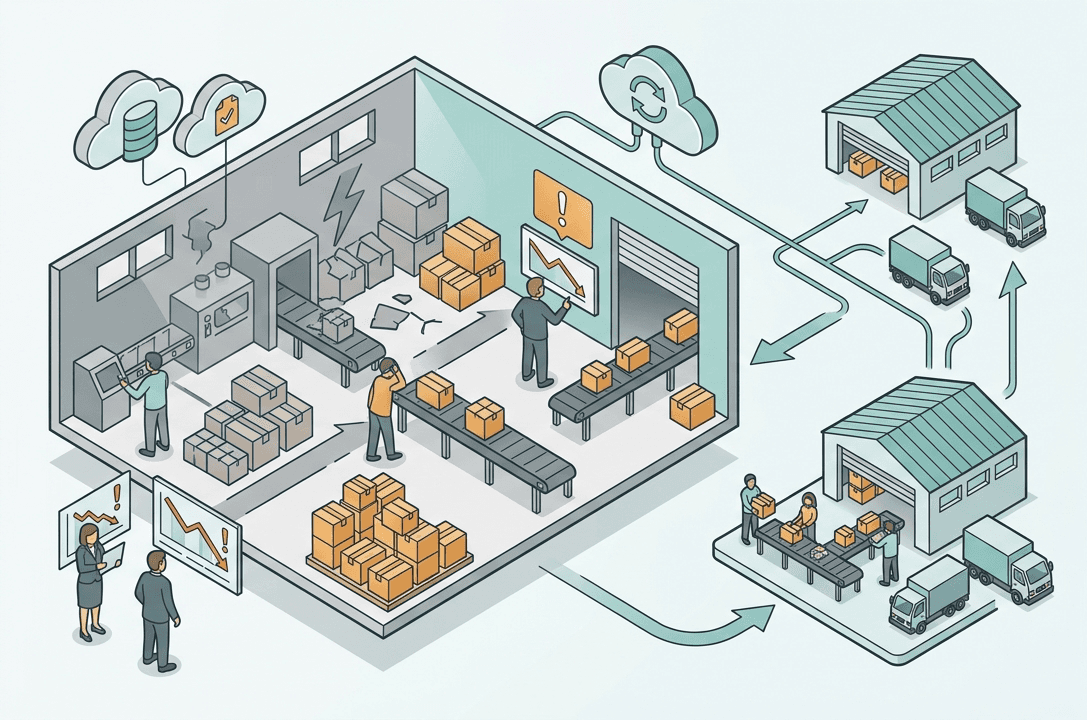
Seasonal volume spikes. In-house operations must lease and staff for peak capacity, Q4, product launches, viral moments. You’re paying for that peak infrastructure twelve months a year, even when you only need it for two. A 3PL absorbs that variability across its entire client base, which means you only pay for what you actually ship.
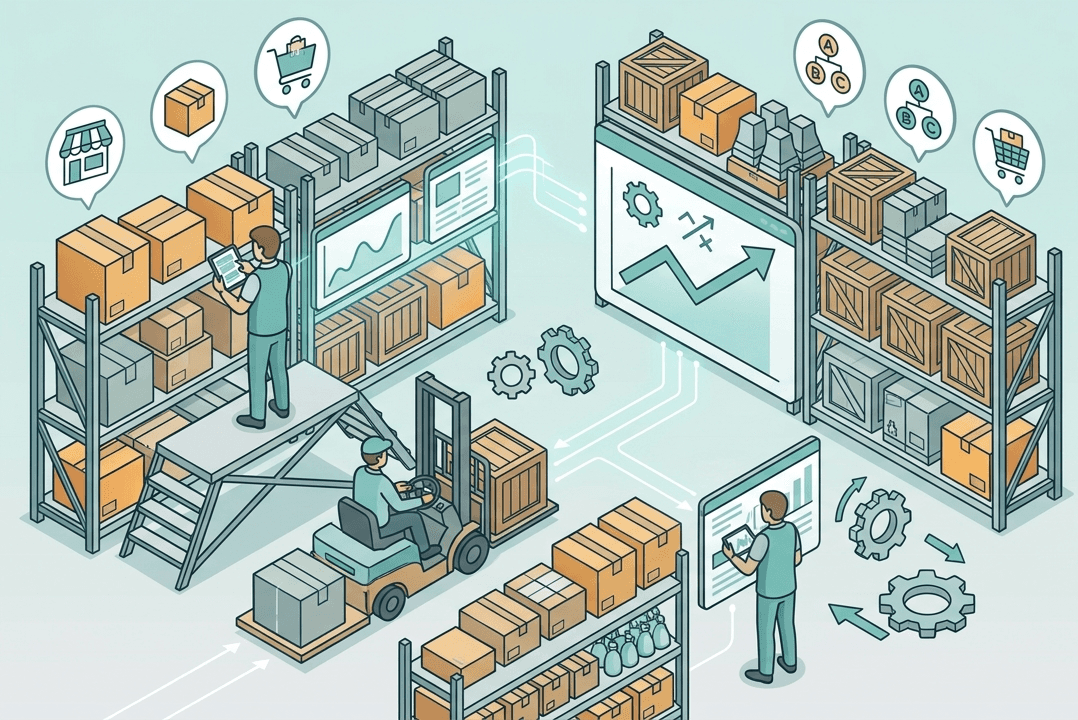
SKU proliferation and kitting complexity. Every new SKU or bundle you add increases storage requirements, pick path complexity, and error risk exponentially. In-house, that means more shelving, more training, and more mistakes. A 3PL’s warehouse management system handles SKU expansion without you adding headcount.
Returns processing. Most brands don’t cost out returns handling in their in-house model. Receiving returned product, inspecting it, deciding whether to restock or dispose, updating inventory, it’s labor-intensive and error-prone when handled manually. A 3PL with a systematic returns workflow turns this from an operational drain into a defined process with predictable costs.
Opportunity cost of operator time. This is the number that breaks the in-house model for most founders. If you or your ops lead is spending 15–20 hours per week managing warehouse operations, that’s 15–20 hours not spent on product development, marketing, retail partnerships, or fundraising. At the growth stage where the 3PL decision matters, your time is almost certainly worth more than the cost difference between the two models.
Ready to Simplify Your Fulfillment?
Let's build a custom pricing model for your brand. No contracts required to start the conversation.