B2B Order Fulfillment: EDI Integration and Retail Distribution Essentials

Michael DeSarno
8 min read
Fulfillment Operations
Share
KEY TAKEAWAYS
• B2B order fulfillment requires EDI integration, routing guide compliance, and precise labeling to avoid costly retail chargebacks.
• Core EDI transaction sets (850, 855, 856, 810) must flow automatically through your 3PL's warehouse management system.
• Retail chargebacks from late shipments, incorrect ASNs, or packing violations can erode wholesale margins fast.
• An omnichannel 3PL with native EDI and dual-coast warehouses lets brands run DTC and B2B from one inventory pool.
Last Updated:
Landing your first major retail account feels like a milestone. And it is. But here is what nobody tells you: the purchase order that follows can break your operations if you are not ready for it.
B2B order fulfillment is a completely different animal from shipping individual DTC orders. The margins for error shrink dramatically. Routing guides are pages long. Chargebacks are real, painful, and add up fast. And the retailers issuing those POs do not care that you are a growing brand. They expect the same compliance from you as they do from a company doing ten times your revenue.
This guide breaks down everything CPG brands need to understand about B2B order fulfillment, from EDI integration to retail distribution logistics, so you can scale your wholesale channel without torching your margins or your reputation.
Why B2B Order Fulfillment Is Nothing Like DTC
If your entire fulfillment experience has been picking, packing, and shipping individual orders to consumers, the jump to B2B will feel jarring. Here is a quick comparison to illustrate the gap.
With DTC, you are shipping one to three items per order, usually in a branded poly mailer or small box. The customer is forgiving if the package arrives a day late. Returns are manageable. Labeling requirements are minimal.
With B2B and wholesale fulfillment for brands, you are shipping cases or pallets to distribution centers that have extremely specific requirements. We are talking about exact label placements, specific pallet configurations, advanced shipping notices (ASNs) transmitted electronically, and delivery windows that, if missed, result in financial penalties.
The biggest differences include:
- Order volume and unit counts: B2B orders are larger, often by orders of magnitude. A single PO from a retailer might represent what your DTC channel does in a month.
- Compliance requirements: Every major retailer has a routing guide. These documents dictate everything from carton dimensions to how shipping labels are oriented. Violating them triggers chargebacks.
- Communication protocols: Retailers expect electronic data interchange (EDI) for purchase orders, invoices, and shipping confirmations. Manual processes do not scale here.
- Delivery precision: Retail distribution centers operate on tight schedules. Your shipment has a specific appointment window, and showing up outside that window means rejection or fees.
Understanding these differences early is the key to building a retail expansion strategy that actually works.
EDI Integration: The Backbone of Retail-Ready Fulfillment
EDI, or electronic data interchange, is the standardized format retailers use to communicate with suppliers. If you have never dealt with it, think of it as the universal language between your brand and the retailer's systems.
Here are the core EDI transaction sets you will encounter in B2B order fulfillment:
- EDI 850 (Purchase Order): The retailer sends this to place an order. It contains item details, quantities, pricing, ship-to addresses, and requested delivery dates.
- EDI 855 (Purchase Order Acknowledgment): Your confirmation that you received the PO and can fulfill it.
- EDI 856 (Advance Ship Notice/ASN): You send this before the shipment arrives, detailing exactly what is in the shipment, how it is packed, and tracking information. This is critical. Missing or inaccurate ASNs are one of the top chargeback triggers.
- EDI 810 (Invoice): Your electronic invoice to the retailer.
Some brands try to handle EDI through manual workarounds or basic web portals that retailers offer as a courtesy. This can work when you have one or two retail accounts processing a handful of POs per month. But as you scale, manual EDI management becomes a bottleneck that leads to errors, late shipments, and chargebacks.
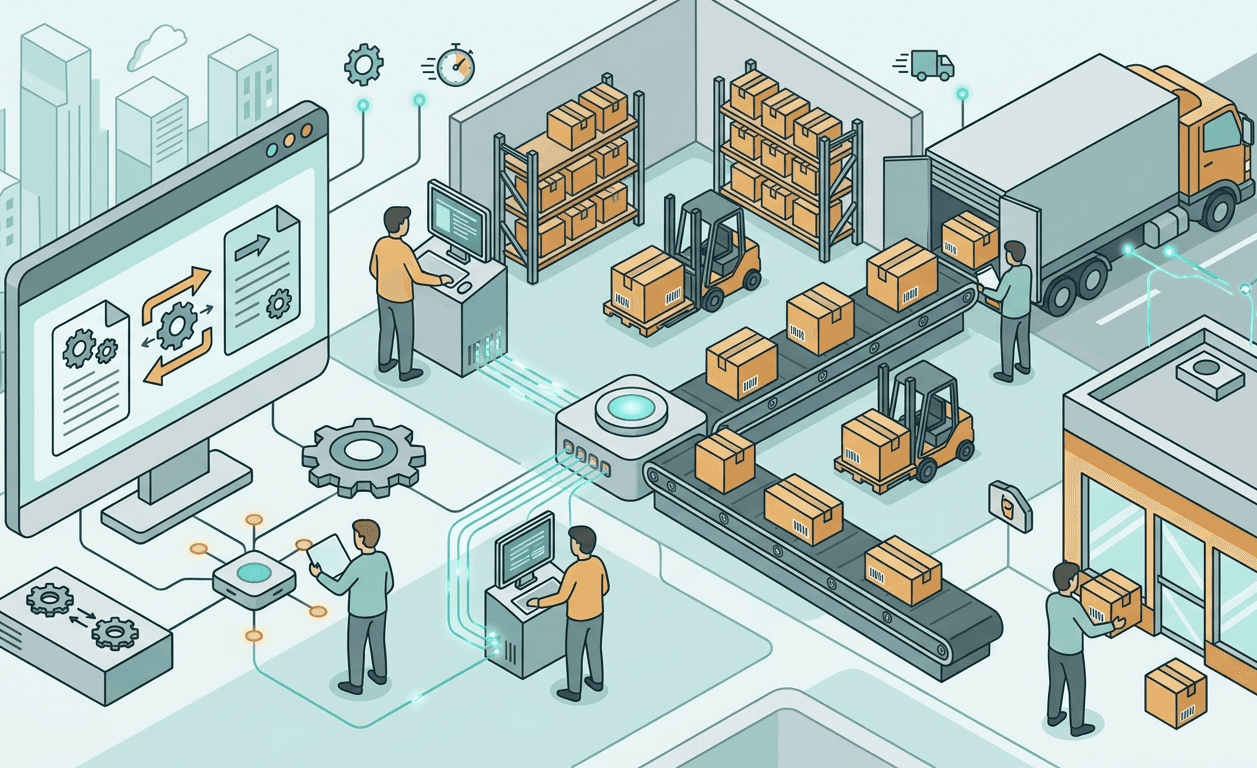
The smarter play is working with a 3PL that has EDI capabilities baked into their warehouse management system. At ShipDudes, EDI compliance is integrated directly into our fulfillment workflows across our New Jersey and Las Vegas facilities. When a PO comes in via EDI 850, it flows into our system, triggers the pick and pack process, generates compliant labels, and transmits the ASN automatically. No copy-pasting between spreadsheets. No manual data entry creating opportunities for mistakes.
Retail Compliance: The Chargeback Trap Nobody Warns You About
Chargebacks are the silent margin killer in B2B order fulfillment. Unlike credit card chargebacks in DTC, retail chargebacks are penalties that retailers deduct from your payment for non-compliance. And they are not small.
Common chargeback triggers include:
- Late shipments: Missing the ship-by date on the PO.
- Incorrect ASNs: The ASN does not match what physically arrives at the DC.
- Labeling errors: Wrong barcode format, incorrect label placement, missing carton markings.
- Packing violations: Wrong carton sizes, incorrect inner pack quantities, pallets that do not meet specifications.
- Missing or incorrect documentation: BOL errors, missing packing slips, wrong PO references.
Each of these can cost you anywhere from a flat fee to a percentage of the PO value. Stack a few of these up across multiple shipments, and you are effectively giving back a significant chunk of your wholesale revenue.
The frustrating part is that most of these chargebacks are completely preventable with the right processes and systems. This is where your retail distribution logistics partner earns their keep. A 3PL experienced in B2B fulfillment will have routing guide compliance procedures already built out for major retailers. They know what Target requires versus what Walmart requires versus what a regional chain expects.
ShipDudes handles retail distribution for CPG brands across beauty, supplements, beverages, pet products, and more. Our team reviews each retailer's routing guide, builds compliant workflows specific to that account, and QCs every outbound B2B shipment before it leaves the warehouse. The goal is zero chargebacks, and while perfection is hard, a rigorous process gets you close.
Building Your Retail Expansion Strategy: Timing and Infrastructure
Not every brand is ready for retail, and that is okay. Jumping into wholesale fulfillment for brands without the right infrastructure is a recipe for chargebacks, stockouts, and burned retail relationships that are hard to rebuild.
Here is a practical checklist to assess your retail readiness:
Inventory depth: Do you have enough inventory to support both your DTC demand and incoming wholesale POs? Retailers will not tolerate fill rate issues. If your PO calls for 5,000 units and you can only ship 3,000, that incomplete shipment creates compliance issues and damages the relationship.
SKU and packaging readiness: Are your products retail-packaged with proper UPC barcodes? Do you have inner packs and master cases configured to retailer specs? Many brands need kitting and assembly services to get their products retail-ready.
Warehouse infrastructure: B2B fulfillment requires space for pallet building, staging areas for outbound freight, and systems that can manage both DTC and B2B workflows simultaneously. Running both channels out of a garage or a single small warehouse creates conflicts.
Technology stack: Your systems need to support EDI, generate compliant labels (GS1-128), and sync inventory across channels in real time. Overselling because your wholesale and DTC inventory is not unified will cause major problems.
Financial readiness: Wholesale means net terms (often net 30, 60, or even 90). You need the cash flow to produce and ship inventory well before you get paid. Factor in potential chargebacks and deductions as well.
If you check most of these boxes, you are in a strong position to pursue retail. If you have gaps, a good 3PL partner can help you close them. ShipDudes works with brands at various stages of their retail expansion strategy, from preparing first shipments to Faire and boutique retailers all the way up to managing ongoing distribution to major national accounts.
Omnichannel Fulfillment: Running DTC and B2B Under One Roof
One of the biggest operational challenges for growing CPG brands is managing DTC and B2B fulfillment simultaneously. These are fundamentally different workflows sharing the same inventory pool, and without the right systems, they create constant friction.
Here is what goes wrong when brands try to run both channels without a unified fulfillment strategy:
- Inventory gets siloed, leading to stockouts on one channel while excess sits in another.
- Warehouse staff context-switches between picking individual eCommerce orders and building pallets for retail POs, creating inefficiency and errors.
- Technology gaps mean manual reconciliation between your Shopify store, your Amazon channel, and your wholesale orders.
The solution is working with an omnichannel 3PL that is built to handle both. ShipDudes integrates with 75+ platforms including Shopify, Amazon, TikTok Shop, Faire, and WooCommerce, while simultaneously managing B2B fulfillment with full EDI compliance. Inventory is unified across channels in real time. DTC orders flow through our 7-day-a-week pick and pack operation, while B2B orders follow their own compliance-driven workflow. Same warehouse, same inventory pool, completely different processes running in parallel without conflict.
Our dual-coast warehouse network (two facilities in Northern New Jersey and two in Las Vegas) also gives brands a geographic advantage for both DTC shipping speeds and B2B distribution logistics, covering the East Coast and West Coast without the complexity of managing multiple 3PL relationships.
Choosing the Right 3PL for B2B Order Fulfillment
Not every 3PL can handle B2B. Many fulfillment companies are optimized exclusively for DTC eCommerce: they are great at shipping individual orders quickly but lack the infrastructure, systems, and experience for retail distribution.
When evaluating a 3PL for wholesale fulfillment, ask these questions:
1. Do you have native EDI capabilities? If they rely on third-party bolt-ons or manual processes, that is a red flag.
2. Can you show me your chargeback rate for existing retail accounts? A good B2B 3PL tracks this and can demonstrate compliance performance.
3. Do you handle both DTC and B2B, or just one? If you need omnichannel, make sure they can genuinely support both without one channel suffering.
4. What retailers have you shipped to? Experience with specific retailers matters because routing guides vary significantly.
5. Is your team US-based? When a PO issue needs resolution at 2 PM on a Tuesday, you need someone who can act immediately. ShipDudes operates with an entirely US-based, in-house team for exactly this reason.
6. Can you handle kitting, assembly, and special packaging? Retail orders often require specific configurations that go beyond standard pick and pack.
The right 3PL partner does not just ship your B2B orders. They protect your retail relationships by ensuring every shipment is compliant, on time, and accurate.
Common Mistakes Brands Make When Entering Wholesale
After working with CPG brands across multiple industries, the ShipDudes team sees the same mistakes repeatedly. Avoid these:
Underestimating lead times: Retail POs have firm ship-by dates. If your production timeline is tight and your 3PL needs time to receive, inspect, and prep inventory, you need to plan backward from that ship date with buffer built in.
Ignoring routing guides: Routing guides are not suggestions. Read them cover to cover. Better yet, have your 3PL review them and build specific SOPs for each retail account.
Not investing in packaging compliance: Retail-ready packaging means proper UPCs, case packs, and labeling. Showing up with DTC packaging to a retail DC will get your shipment rejected.
Treating B2B fulfillment as an afterthought: Some brands bolt on wholesale as a side project while focusing on DTC. Both channels need dedicated attention, processes, and resources.
Choosing the cheapest 3PL: In B2B fulfillment, the cheapest option often becomes the most expensive when chargebacks start stacking up. Invest in a partner with proven retail distribution logistics capabilities.
FAQ: B2B Order Fulfillment
What is B2B order fulfillment?
B2B order fulfillment is the process of receiving, processing, and shipping orders from one business to another. For CPG brands, this typically means fulfilling wholesale purchase orders to retailers, distributors, or other businesses. Unlike DTC fulfillment, B2B requires compliance with retailer-specific routing guides, EDI communication, and precise labeling and packing standards.
What is EDI and why does it matter for wholesale fulfillment?
EDI (electronic data interchange) is a standardized digital format for exchanging business documents like purchase orders, invoices, and shipping notices between companies. It matters because most major retailers require EDI for all supplier communications. Without EDI capability, you cannot efficiently process retail POs or transmit the advance shipping notices that retailers require before accepting deliveries.
How do retail chargebacks work?
Retail chargebacks are financial penalties that retailers deduct from supplier payments for non-compliance with their requirements. Common triggers include late shipments, inaccurate ASNs, labeling errors, and packing violations. Chargebacks can range from flat fees to percentages of the order value and can significantly erode wholesale margins if not managed proactively.
Can a 3PL handle both DTC and B2B fulfillment?
Yes, but not all 3PLs are equipped for it. An omnichannel 3PL like ShipDudes is designed to run DTC eCommerce fulfillment and B2B retail distribution from the same facility with unified inventory management. This eliminates the need for separate fulfillment partners and prevents inventory fragmentation across channels.
When should a brand start considering B2B fulfillment?
Brands should consider B2B fulfillment when they have sufficient inventory depth, retail-ready packaging with proper UPC codes, the cash flow to support net payment terms, and either the internal infrastructure or a 3PL partner capable of handling EDI and retail compliance requirements.
Ready to Scale Your Wholesale Channel?
If you are a CPG brand looking to expand into retail or streamline your existing B2B order fulfillment, ShipDudes can help. Our dual-coast warehouse network, native EDI integration, and retail compliance expertise are built to protect your margins and your retail relationships.
Book a call with our team to discuss your B2B fulfillment needs: [shipdudes.com/book-a-call](https://shipdudes.com/book-a-call)
Ready to Simplify Your Fulfillment?
Let's build a custom pricing model for your brand. No contracts required to start the conversation.