
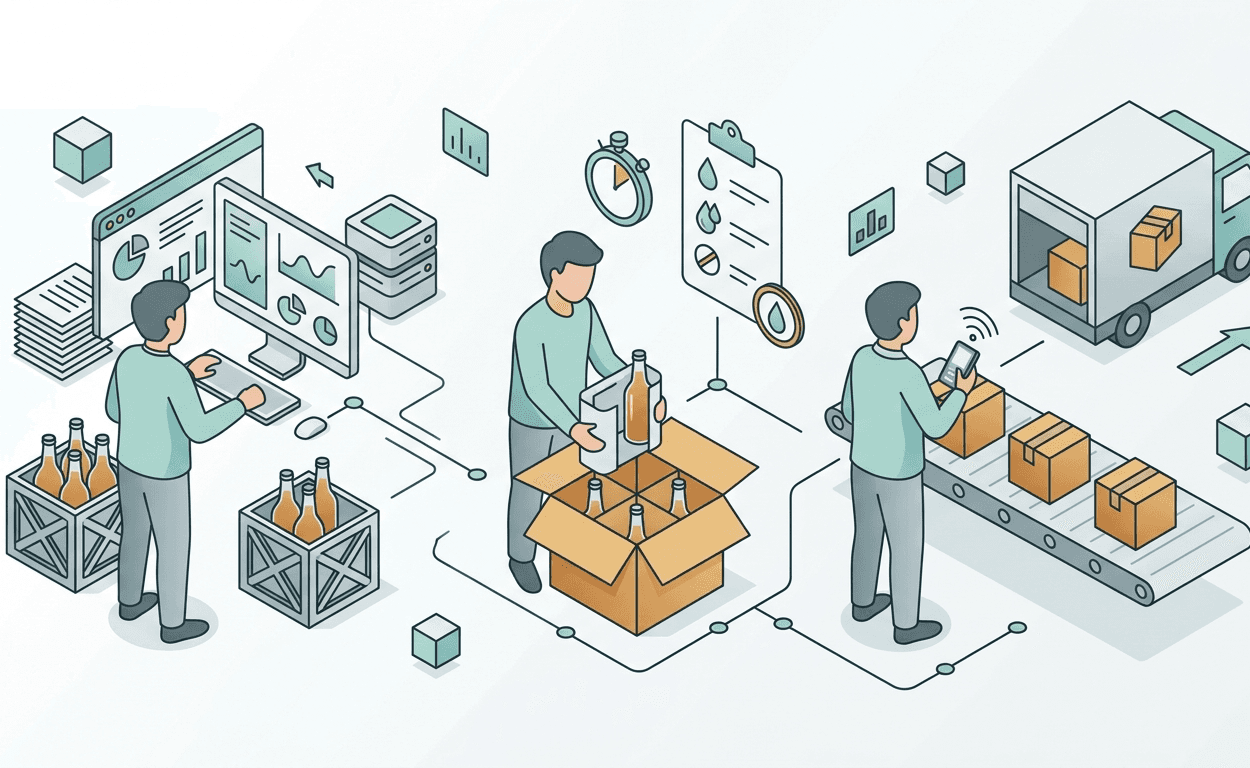
Beverage Fulfillment Challenges: Glass, Liquid Restrictions, and Shipping Solutions

Michael DeSarno
8 min read
Fulfillment Operations
Share
KEY TAKEAWAYS
• Beverage fulfillment requires specialized glass packaging, carrier liquid compliance, and weight-based shipping optimization that general 3PLs lack.
• Dual-coast warehouses (NJ + Las Vegas) cut shipping costs on heavy beverages by reducing average zone distance.
• Carrier restrictions on liquids include secondary waterproof containment, orientation labels, and volume limits per package.
• Omnichannel fulfillment from one inventory pool covers DTC, Amazon, retail EDI, and subscription kitting for beverage brands.
Last Updated:
If you sell beverages online, you already know the truth that most 3PLs won't tell you upfront: beverage fulfillment is one of the hardest categories in eCommerce logistics. Between fragile glass bottles, heavy case weights that blow up shipping costs, carrier restrictions on liquids, and the constant threat of leaks ruining an entire shipment, the margin for error is razor thin.
We built ShipDudes specifically for CPG brands that face these kinds of operational headaches. As founders who lived through fulfillment nightmares ourselves, we understand that beverage brands don't just need a warehouse. They need a partner who has solved these problems before and can prove it.
This post breaks down the biggest beverage fulfillment challenges, explains why they trip up so many brands, and walks through practical solutions that actually work at scale.
Why Beverage Fulfillment Is Uniquely Difficult
Let's start with the basics. Beverages combine almost every hard variable in fulfillment into a single product category:
- Weight. Liquids are heavy. A case of 12 glass bottles can easily hit 20 to 30 pounds, pushing you into higher shipping rate tiers fast.
- Fragility. Glass bottles and even aluminum cans require careful handling. One broken bottle in a multi-unit order can destroy the entire package.
- Leak risk. Even with intact containers, temperature changes and pressure shifts during transit can cause lids to loosen or seals to fail.
- Carrier restrictions. Major carriers like UPS, FedEx, and USPS all have specific rules about shipping liquids, and those rules vary by product type.
- Temperature sensitivity. Some beverages degrade in extreme heat or cold, limiting shipping windows and requiring strategic warehouse placement.
Most general purpose 3PLs treat beverages the same way they treat t-shirts or phone cases. That approach leads to broken glass, angry customers, and refund requests that eat your margin alive. The supply chain challenges for founders in this space are real, and they require purpose-built solutions.
The Glass Problem: Breakage, Packaging, and Cost
Glass is the single biggest pain point in beverage fulfillment. It looks premium on your website and feels great in the customer's hand. But between your warehouse shelf and their doorstep, glass is a liability.
Here's what actually causes breakage in transit:
Insufficient inner packaging. Many brands underestimate how much cushioning glass needs. A single layer of bubble wrap is not enough. Each bottle needs individual protection, and the void space inside the box needs to be filled so nothing shifts during transit.
Wrong box sizing. Using a box that's too large creates movement. Using one that's too tight puts pressure on the glass. The right box for a two-bottle order is different from the right box for a six-bottle order, and your fulfillment partner needs to stock multiple sizes.
Poor palletization upstream. Breakage doesn't always happen in the last mile. Sometimes bottles arrive at the warehouse already cracked because they were poorly palletized during inbound freight. A good 3PL catches this at receiving and flags it before those units enter inventory.
At ShipDudes, we work with beverage brands to develop custom packaging protocols for glass products. That means testing different box configurations, inner packaging materials, and cushioning approaches until we find the combination that brings breakage rates down to near zero. We also run quality checks at receiving so damaged inventory never makes it to a pick shelf.
Liquid Shipping Restrictions: What Most Founders Don't Know
Here's a scenario we see all the time: a beverage founder launches their DTC site, starts getting orders, and then discovers that their product has carrier restrictions they never planned for.
The major carriers all allow non-hazardous liquids, but they impose conditions:
- Inner packaging requirements. Carriers typically require that liquid containers be sealed inside a secondary waterproof layer (like a sealed poly bag) so that if a leak occurs, it doesn't damage other packages in the same truck.
- Labeling. Packages containing liquids often need specific orientation labels ("This Side Up") and may require ORM-D or Limited Quantity markings depending on the product.
- Volume limits. Some carriers cap the amount of liquid per package. If you're shipping a case of 12 bottles, you may need to split it into two shipments depending on total fluid ounces.
- Alcohol restrictions. If your beverage contains alcohol, even in small amounts, the rules get significantly more complex. Many carriers won't ship alcohol at all without special licensing and compliance agreements.
Getting any of this wrong doesn't just mean a returned package. It can mean fines, suspended carrier accounts, or refused shipments during peak season when you can least afford it.
This is where experienced cpg fulfillment services earn their value. A fulfillment partner that already ships beverages daily will have these protocols baked into their SOPs. They won't be guessing at compliance. They'll already have the right packaging materials, the right labels, and the right carrier relationships in place.
Weight-Based Shipping: The Margin Killer Nobody Talks About
Beverages are dense. That's just physics. And because carriers price by dimensional weight or actual weight (whichever is greater), beverage brands almost always get hit with actual weight charges.
Here's what that looks like in practice. A subscription box brand selling four bottles of cold-pressed juice per box might have a product that weighs 8 to 10 pounds after packaging. Shipping that from a single warehouse on the East Coast to a customer in California can cost twice as much as shipping it to someone in New York.
The most effective solution? Distributed inventory across multiple fulfillment centers.
ShipDudes operates dual-coast warehouses in Northern New Jersey and Las Vegas. For beverage brands, this geographic spread is a game changer. By splitting inventory between East and West Coast facilities, you reduce the average shipping zone for every order. That means lower carrier costs, faster delivery times, and fewer packages sitting on trucks for five or six days in the summer heat.
This is one of the most impactful scalable fulfillment solutions available to growing beverage brands, and it doesn't require the complexity of managing four or five warehouses. Two strategically placed facilities cover the vast majority of the US population within a two to three day ground shipping window.
Temperature and Seasonal Considerations
Not all beverages are shelf-stable, but even those that are can suffer in extreme temperatures. Kombucha, protein shakes, certain juices, and functional beverages can all degrade when exposed to prolonged heat during transit.
There are a few ways to manage this:
Seasonal shipping adjustments. During summer months, switching from ground to expedited shipping for heat-sensitive products can prevent spoilage. Yes, it costs more per package. But it costs less than replacing spoiled orders and dealing with negative reviews.
Insulated packaging. Insulated liners and gel packs can maintain safe temperatures for 24 to 48 hours. This works well for two-day shipping lanes but becomes impractical for five-day ground shipments in July.
Strategic warehouse selection. Shipping from a facility closer to the customer reduces time in transit, which reduces heat exposure. This is another reason why dual-coast fulfillment matters for beverage brands.
At ShipDudes, we help brands evaluate these tradeoffs and build seasonal shipping strategies that protect product quality without destroying margins.
B2B and Retail Distribution for Beverages
DTC is where most beverage brands start, but retail is where many of them scale. Landing accounts with retailers, grocery chains, or platforms like Faire means you need a fulfillment partner that can handle B2B distribution with precision.
Retail orders come with a different set of requirements:
- EDI compliance. Major retailers require electronic data interchange for purchase orders, advance ship notices, and invoicing. If your 3PL can't handle EDI, you'll be managing it manually, which is a recipe for chargebacks.
- Case pack configurations. Retailers want products shipped in specific case quantities with specific labeling. Your fulfillment partner needs to manage these configurations without mixing up SKUs.
- Pallet requirements. Many retailers have strict palletization standards. Wrong pallet type, wrong stacking pattern, or missing labels can get your shipment rejected at the dock.
ShipDudes provides EDI-compliant B2B and retail distribution as a core service. We work with beverage brands that sell across DTC, Amazon, TikTok Shop, Faire, and traditional retail, all from the same inventory pool. That omnichannel capability is critical for brands that don't want to manage separate fulfillment workflows for every sales channel.
Subscription Beverage Fulfillment: Kitting Done Right
Subscription boxes are a natural fit for beverages. Monthly deliveries of craft sodas, health drinks, coffee, or cocktail mixers build recurring revenue and customer loyalty. But subscription fulfillment adds complexity.
Every month, you might have a different product mix in the box. That means your 3PL needs to handle kitting and assembly, building custom boxes from multiple SKUs according to that month's plan. They also need to manage inventory across all those SKUs so you don't run out of one ingredient mid-cycle.
ShipDudes handles subscription box fulfillment with dedicated kitting and assembly services. We coordinate with brands on their monthly box configurations, pre-kit inventory when possible to speed up processing, and manage the cycle so that every subscriber gets their box on time.
Choosing the Right 3PL for Beverage Fulfillment
If you're evaluating 3PL partners for your beverage brand, here are the questions that actually matter:
1. Do you currently fulfill beverage products? Experience matters. Ask for references from other beverage brands they work with.
2. What packaging protocols do you use for glass? If they can't describe a specific process, they don't have one.
3. How many fulfillment centers do you operate, and where? Dual-coast (or more) is the minimum for managing shipping costs on heavy products.
4. Can you handle both DTC and B2B from the same inventory? Omnichannel capability prevents you from outgrowing your 3PL when you land retail accounts.
5. What's your processing time? ShipDudes offers 7-day processing for pick and pack, with an all in-house, US-based team. No overseas support, no communication gaps.
6. What platforms do you integrate with? ShipDudes connects with 75+ platforms including Shopify, Amazon, WooCommerce, TikTok Shop, and Faire.
The Bottom Line for Beverage Brands
Beverage fulfillment is hard. But it's not unsolvable. The brands that win are the ones that partner with a 3PL that has already figured out the glass packaging, the carrier compliance, the weight optimization, and the omnichannel distribution.
ShipDudes was founded by eCommerce entrepreneurs who lived through the pain of working with fulfillment partners that weren't built for complex products. We serve beauty, pet products, supplements, small electronics, shelf-stable food, and beverages because we understand what CPG brands need: reliability, flexibility, and a team that operates like an extension of yours.
If you're a beverage founder dealing with breakage, high shipping costs, or a 3PL that treats your glass bottles like paperback books, it's time for a change.
Book a call with ShipDudes today at [shipdudes.com/book-a-call](https://shipdudes.com/book-a-call) and let's build a fulfillment strategy that actually works for your product.
Frequently Asked Questions About Beverage Fulfillment
What makes beverage fulfillment different from other eCommerce fulfillment?
Beverage fulfillment involves unique challenges including heavy product weight, glass fragility, liquid shipping restrictions from carriers, and temperature sensitivity. These factors require specialized packaging protocols, carrier compliance knowledge, and strategic warehouse placement that general purpose 3PLs often lack.
Can I ship glass bottles through UPS or FedEx?
Yes, both UPS and FedEx allow glass bottles to be shipped, but they require specific packaging standards. This typically includes individual bottle protection, secondary waterproof containment, void fill to prevent movement, and proper orientation labeling. Working with an experienced beverage fulfillment partner like ShipDudes ensures compliance with all carrier requirements.
How do I reduce shipping costs for heavy beverage products?
The most effective strategy is distributing inventory across multiple fulfillment centers to reduce average shipping zones. ShipDudes operates dual-coast facilities in Northern New Jersey and Las Vegas, which significantly lowers shipping costs for beverage brands by keeping packages closer to end customers.
Does ShipDudes handle both DTC and retail fulfillment for beverages?
Yes. ShipDudes provides omnichannel fulfillment including DTC pick and pack, B2B retail distribution with full EDI compliance, Amazon FBA prep, and subscription box kitting. All channels are fulfilled from the same inventory pool, which simplifies operations for growing beverage brands.
What industries does ShipDudes specialize in?
ShipDudes specializes in CPG fulfillment services across beverages, beauty, pet products, supplements, shelf-stable food, small electronics, and general consumer packaged goods. The company was recognized on the Inc. 5000 list as the 39th fastest growing company in America.
Ready to Simplify Your Fulfillment?
Let's build a custom pricing model for your brand. No contracts required to start the conversation.