Ecommerce Order Fulfillment Explained: From Checkout to Customer Doorstep

Michael DeSarno
8 min read
Fulfillment Operations
Share
KEY TAKEAWAYS
• Ecommerce order fulfillment is the full chain from receiving inventory to delivering orders and processing returns, not just shipping.
• Each step (receiving, storage, pick/pack, shipping, returns) has distinct costs and failure modes that cascade downstream.
• Smart 3PL selection converts fixed warehouse costs to variable per-order fees and recovers founder time.
• For brands doing 200 to 5,000 orders per month, outsourcing fulfillment is typically the highest-leverage operational move.
Last Updated:
What Is Ecommerce Order Fulfillment (And Why It's More Complex Than It Looks)
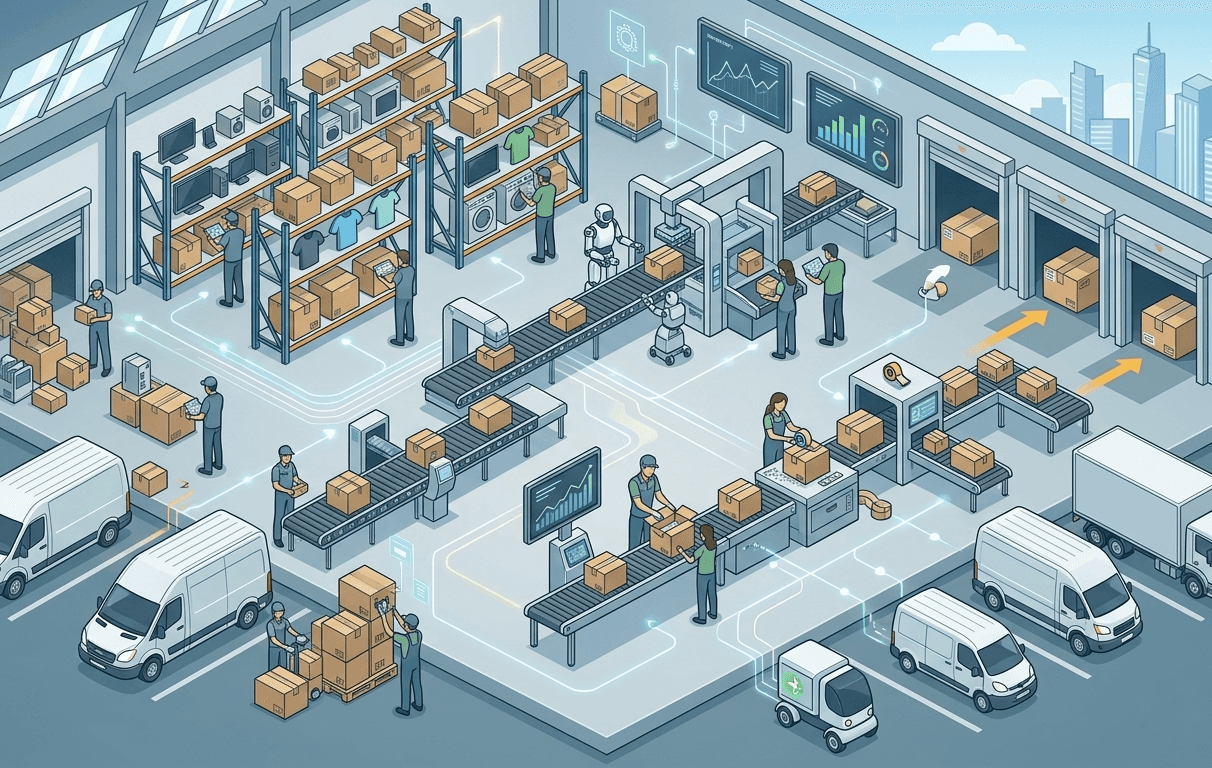
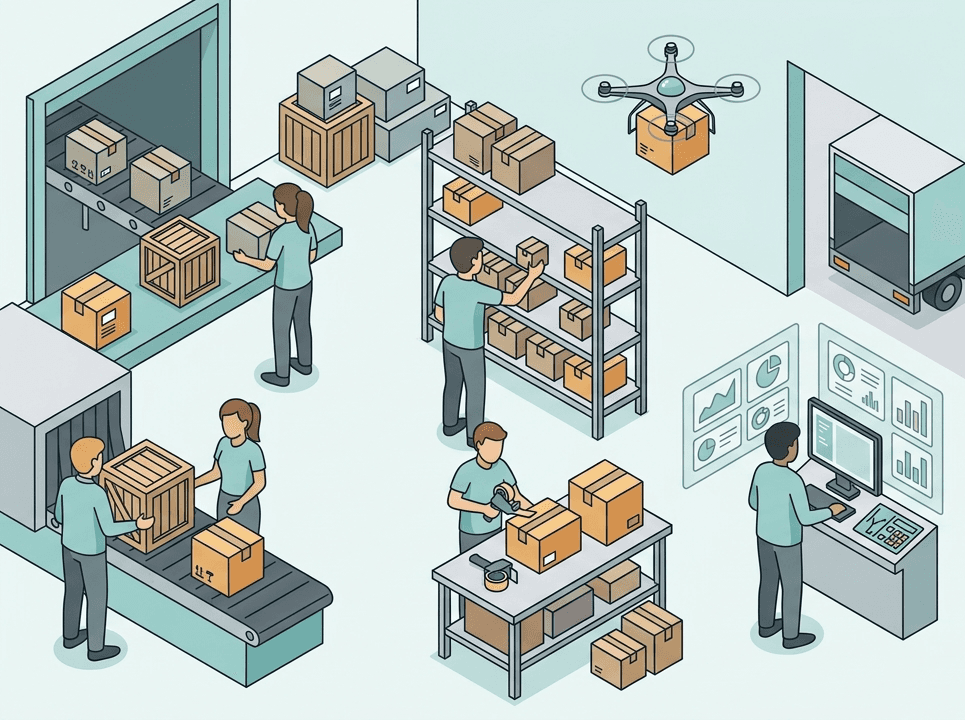
Ecommerce order fulfillment is the end-to-end process of receiving inventory, storing it, picking and packing individual orders, shipping them to customers, and handling returns when products come back. It's everything that happens between a customer clicking "buy" and a package landing on their doorstep.
A common mistake founders make is treating "fulfillment" and "shipping" as interchangeable. Shipping is one step inside a much larger operational chain. Fulfillment is the entire system, and when any single step breaks down, it cascades. A receiving error creates phantom inventory. Phantom inventory causes overselling. Overselling generates cancellations, refunds, and one-star reviews. The chain reaction starts long before a package ever reaches a carrier.
Fulfillment complexity scales faster than most founders expect. Every new SKU, sales channel, and warehouse location adds moving parts. A brand selling three products on Shopify has a fundamentally different operational footprint than the same brand selling thirty products across Shopify, Amazon, TikTok Shop, and Faire. The steps are the same whether you fulfill in-house or through a 3PL. The question is who owns each one and how well they execute it.
Step 1: Inbound Receiving, Getting Inventory Into the Warehouse
Receiving is the process of accepting inbound freight from your manufacturer or supplier and logging it accurately into a warehouse management system (WMS). It sounds simple, but this is where a surprising number of fulfillment problems originate.
Good receiving looks like this: each inbound shipment is checked at the SKU level for quantity verification, inspected for damage, labeled if needed, and assigned to specific bin locations in the warehouse. It's not just unloading pallets and stacking them. It's creating an accurate digital record that your entire fulfillment operation depends on.
Bad receiving is invisible until it isn't. If 50 units arrive but only 45 get scanned in, your system thinks you have 45 when you actually have 50. Or worse, if damaged units aren't flagged, they get shipped to customers. These errors don't show up for days or weeks, and by then they've cascaded into overselling, mispicks, and customer complaints.
Brands that send advance shipping notices (ASNs) to their fulfillment partner reduce receiving errors and speed up inbound processing significantly. If your 3PL doesn't provide receiving confirmation with unit counts and condition photos, that's a gap worth asking about.
Step 2: Warehousing and Inventory Storage
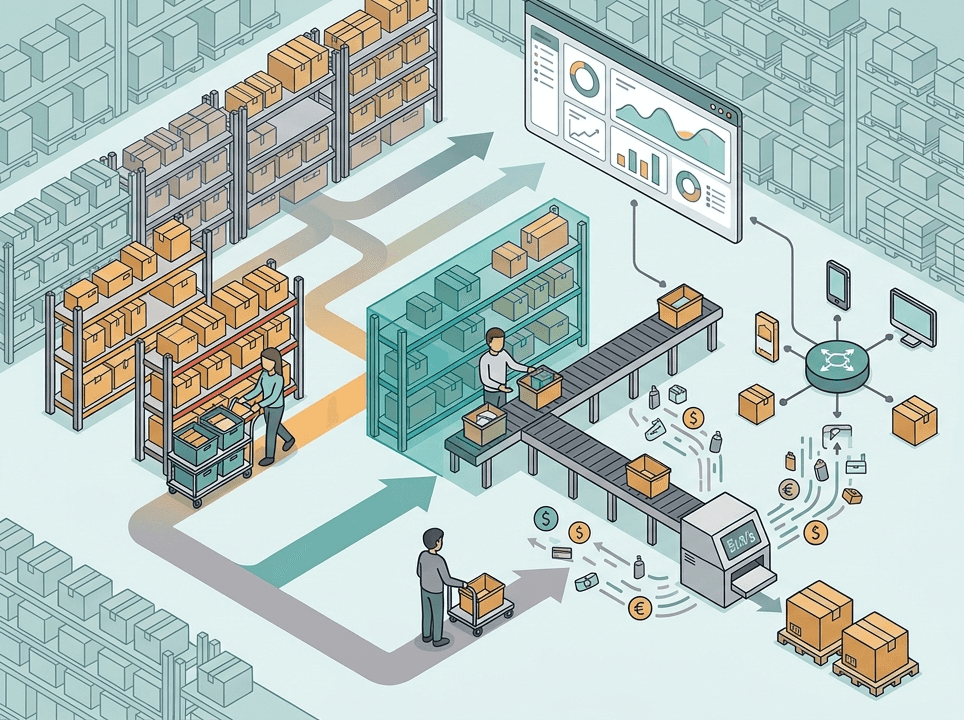
Storage isn't passive. Smart slotting, which means placing your fastest-moving SKUs in the most accessible pick locations, directly impacts pick speed and labor cost. A well-organized warehouse can fulfill the same order volume with fewer staff hours than a poorly slotted one, which is why experienced 3PLs treat slotting optimization as an ongoing process, not a one-time setup.
In a proper WMS, inventory is tracked at the bin and lot level. For CPG brands selling consumable products like supplements, food, and skincare, this matters because of FEFO (first expired, first out) compliance. You need the system to automatically route pickers to the oldest lot first, not the most convenient shelf location. Without lot-level tracking, you risk shipping expired product and dealing with recalls or customer complaints.
Most 3PLs charge monthly storage fees per pallet, per bin, or per cubic foot of space your inventory occupies. Understanding this fee structure is essential for forecasting your landed cost per unit accurately, especially if you carry seasonal inventory or slow-moving SKUs that accumulate storage charges over time.
Real-time inventory visibility through an integrated dashboard is table stakes now, not a premium feature. You should be able to see current stock levels, inbound shipment status, and low-stock alerts without emailing your account manager. If kitting or bundling is part of your product strategy (subscription boxes, gift sets, variety packs), that assembly work happens at the warehouse level and should be visible in the same system.
Step 3: Pick and Pack, Where Accuracy Meets Speed
Pick and pack is the operational core of fulfillment. A warehouse associate (or in some facilities, an automated system) locates the correct SKU, pulls the right quantity, packages it according to your order specifications, and prepares it for carrier handoff. This is where speed, accuracy, and brand presentation all converge.
Brands often underestimate how many decisions live inside the "pack" step. Custom packaging, branded tissue paper, marketing inserts, thank-you cards, specific box sizes for specific products: these are decisions you make, and your 3PL executes. The more specific your pack-out instructions, the more consistent your customer's unboxing experience. Ambiguity here is how you end up with products rattling around in oversized boxes with no inserts.
Pick accuracy rates matter enormously at scale. At 99% accuracy and 1,000 orders per month, you're generating 10 wrong orders. That's 10 support tickets, 10 reshipping costs, 10 customers who may not come back. That's why the industry benchmark is 99.5% or higher, and why serious 3PLs use barcode scanning and WMS-generated pick lists at every step rather than relying on manual picking, which degrades as volume and SKU count grow.
The fee structure here is straightforward but important to model: most 3PLs charge a base pick fee per order plus a per-item fee for each additional unit. If your average order contains three items, your pick cost is the base fee plus two additional item fees. Run this math against your actual order profile before signing anything.
Step 4: Shipping and Carrier Selection
Shipping is the handoff point. Once the carrier scans the package, it leaves the fulfillment center's operational control, but the brand still owns the customer experience. A late delivery or a lost package is your problem in the customer's eyes, not the carrier's.
Behind the scenes, the shipping step involves carrier selection logic: rate shopping across USPS, UPS, FedEx, and regional carriers based on package weight, dimensions, destination zone, and the delivery speed you've promised. A good 3PL automates this to select the cheapest carrier option that still meets your delivery commitment.
One cost concept that catches founders off guard is dimensional weight (DIM weight) pricing. Carriers charge based on either actual weight or dimensional weight, whichever is higher. If you're shipping lightweight but bulky products, DIM weight can double your expected shipping cost. This is why right-sizing your packaging matters and why experienced 3PLs invest in box optimization.
Shipping confirmation with tracking is the minimum expectation. Automated tracking emails should push to customers the moment a label is created, with carrier status updates throughout transit. Delays happen, but delays without communication are what kill repeat purchase rates. Your fulfillment partner should make this seamless, not something you manage manually.
Finally, understand your 3PL's shipping cutoff time. Orders placed before a daily cutoff (say, 2 PM local warehouse time) ship same day. Orders after cutoff ship next business day. This cutoff directly affects the delivery promise you can make on your product pages and in your marketing.
Step 5: Returns Management (Reverse Logistics)
Returns are a distinct operational function, not just "shipping in reverse." Reverse logistics includes receiving returned packages, inspecting product condition against brand-defined criteria, making a disposition decision (restock, refurbish, or destroy), updating inventory, and triggering customer refunds. Each step has its own cost and complexity.
The cost reality is sobering: returns processing typically costs as much or more per unit than outbound fulfillment. Brands that ignore returns in their unit economics get surprised when a 15% return rate eats significantly into margins. This is especially relevant for categories with higher return rates like apparel, but even CPG brands deal with damaged-in-transit, wrong-item, and buyer's-remorse returns.
The strategic angle most founders miss is that a clean returns process with fast refund turnaround is a customer retention lever, not just a cost center. Customers who have a frictionless return experience are significantly more likely to purchase again than those who don't. Your 3PL should receive a written returns policy from you: what condition is resellable, what gets destroyed, what triggers an automatic refund. Ambiguity here creates expensive mistakes on both sides.
In-House vs. Outsourced: The Real Trade-Off
This isn't a binary decision. In-house fulfillment makes sense at very low volume or when you need extreme process control over the unboxing experience. A 3PL makes sense when you want to convert fixed costs (lease, labor, equipment) to variable costs (per-order fees) and buy back the founder time that's currently spent managing warehouse operations.
A good 3PL should give you three things: fulfillment infrastructure without capital investment, carrier rate access you can't negotiate at your volume, and operational expertise so you're not rebuilding the wheel. The trade-off is control. You're trusting someone else to execute the last physical touchpoint your customer has with your brand. That's why the evaluation process matters as much as the decision itself.
For most DTC and CPG brands in the 200 to 5,000 orders-per-month range, outsourcing fulfillment is the highest-leverage operational decision available. It's not about whether you can handle fulfillment in-house. It's about whether that's the best use of your team's time and your company's cash.
Ready to Simplify Your Fulfillment?
Let's build a custom pricing model for your brand. No contracts required to start the conversation.