
Inventory Aging Analysis: How to Liquidate Dead Stock Before It Kills Your Cash Flow

Michael DeSarno
8 min read
Inventory Management
Share
KEY TAKEAWAYS
• Inventory aging analysis segments stock by how long it has sat unsold, revealing cash trapped in dead inventory.
• Dead stock (typically 180+ days unsold) should be liquidated through bundles, markdowns, or wholesale channels before storage fees compound.
• A 3PL with real-time inventory visibility (like ShipDudes' 75+ integrations) automates aging reports so brands act before margin erodes.
• ShipDudes operates from 2 NJ and 2 Las Vegas warehouses with 7-day processing to help brands move aging inventory fast.
Last Updated:
Here's a number most brand operators don't want to face: roughly 20 to 30 percent of the inventory sitting in your warehouse right now will never sell at full price. It just sits there, silently burning cash through storage fees, tying up capital you could be reinvesting in product development or marketing, and slowly creeping toward its expiration date (literal or figurative).
An inventory aging analysis is the single most powerful tool you have to fight this. It's not complicated. It's not some enterprise-level analytics project. It's a disciplined process of categorizing your stock by how long it's been sitting, then making hard decisions about what to do with the stuff that isn't moving. Let's walk through exactly how to do it.
What Is Inventory Aging Analysis and Why Should You Care?
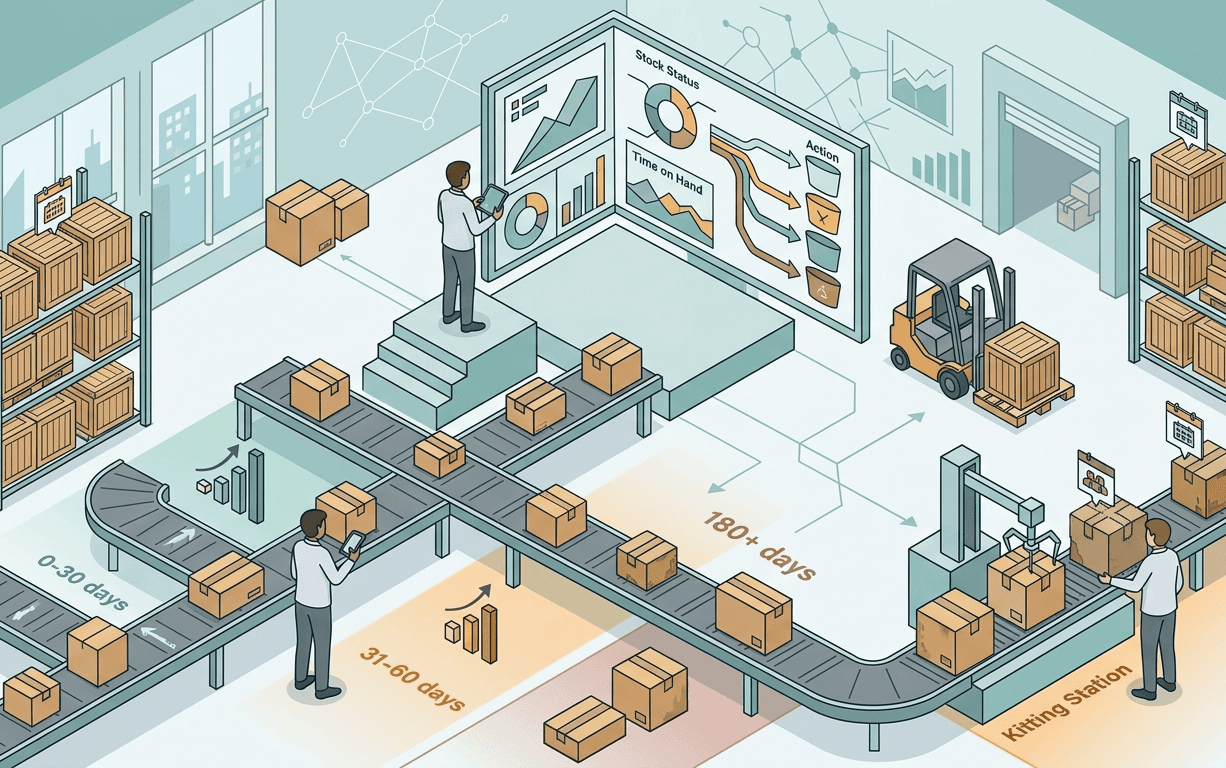
Inventory aging analysis is the process of segmenting your on-hand stock into time-based buckets (typically 0 to 30 days, 31 to 60 days, 61 to 90 days, 91 to 180 days, and 180+ days) to understand how long each SKU has been sitting in your warehouse without selling.
The goal is simple: identify slow moving inventory before it becomes dead stock, and take action while you still have options.
Why does this matter so much for CPG brands? Because warehouse storage costs are not static. Most 3PLs charge on a per-pallet or per-cubic-foot basis, and those fees compound month after month. A pallet of product that hasn't moved in six months has now cost you six months of storage, plus the original cost of goods, plus the opportunity cost of capital you could have deployed elsewhere. For brands working with a [3PL inventory management system](https://shipdudes.com/blog/3pl-inventory-management-systems-real-time-visibility-and-control), this data should be accessible in real time. If it's not, that's a problem worth solving immediately.
How to Build Your Aging Report: A Step-by-Step Framework
You don't need expensive software to start. You need accurate data and a willingness to look at it honestly.
Step 1: Pull your current inventory snapshot. Export every SKU, its quantity on hand, and the date it was received into your warehouse. If you're selling across multiple channels, make sure you're working with a [multi-channel inventory sync](https://shipdudes.com/blog/multi-channel-inventory-sync-how-to-prevent-overselling-across-shopify-amazon-and-tiktok-shop) so the numbers reflect reality across Shopify, Amazon, TikTok Shop, and everywhere else you sell.
Step 2: Calculate days on hand. For each SKU, subtract the received date from today's date. If you've received multiple shipments of the same SKU, use a FIFO (first in, first out) approach and age the oldest units first.
Step 3: Bucket your inventory. Sort everything into aging categories:
- 0 to 30 days: Fresh stock, healthy
- 31 to 60 days: Monitor closely
- 61 to 90 days: Needs a plan
- 91 to 180 days: Slow moving inventory, take action now
- 180+ days: Dead stock, liquidate or write off
Step 4: Calculate the carrying cost for each bucket. Multiply units by your monthly storage cost per unit, then multiply by the number of months they've been sitting. This is the number that makes operators lose sleep, and it should.
Step 5: Cross-reference with sell-through rate. A SKU sitting for 90 days that sells 50 units per week is a different conversation than a SKU sitting for 90 days that sells 2 units per month. Context matters.
The Real Cost of Dead Stock (It's Worse Than You Think)
Most brands calculate dead stock cost as simply the cost of goods sold. That's only the beginning. The true cost includes:
- Monthly warehouse storage costs that accumulate every billing cycle
- Capital lockup preventing you from investing in faster-moving products or new launches
- Increased pick path complexity that can slow down fulfillment of your healthy SKUs
- Potential disposal fees if product expires or becomes unsellable
- Insurance costs on inventory value you're never going to recover
For brands in categories like supplements or beauty, there's an additional layer: expiration dates. A supplement with a 24-month shelf life that's been sitting for 12 months is already halfway to worthless. If you're in this space, your [supplement fulfillment](https://shipdudes.com/blog/supplement-fulfillment-fda-compliance-lot-tracking-and-expiration-management) partner should be flagging lot-level aging data proactively, not waiting for you to ask.
At ShipDudes, we see this pattern regularly with brands who come to us after outgrowing their previous setup. Their old fulfillment partner was charging storage fees but never once flagged that 30 percent of their inventory hadn't moved in six months. A good 3PL partner should be surfacing this data before you even know to ask for it.
Five Strategies for Dead Stock Liquidation
Once your aging analysis identifies the problem SKUs, you need a playbook. Here are five proven approaches, ranked from most to least margin-preserving.
1. Bundle with fast movers. Take your dead stock and pair it with your best sellers as a "bonus" or value bundle. This is where [kitting and assembly services](https://shipdudes.com/blog/kitting-and-assembly-services) become critical. Your 3PL should be able to create new bundle SKUs without requiring you to ship inventory back to your office for re-packaging.
2. Flash sales on secondary channels. Run a steep discount through a channel you don't normally prioritize. If you're primarily DTC on Shopify, consider a [TikTok Shop fulfillment](https://shipdudes.com/blog/tiktok-shop-fulfillment-complete-guide-for-social-commerce-success) flash sale or a liquidation listing on Amazon. The point is to move volume quickly without training your core customer base to wait for discounts.
3. B2B and wholesale liquidation. Offload aging inventory to discount retailers, closeout buyers, or wholesale channels at reduced margins. If your 3PL supports [B2B order fulfillment](https://shipdudes.com/blog/b2b-order-fulfillment-edi-integration-and-retail-distribution-essentials) with EDI compliance, you can route these orders without disrupting your DTC operations.
4. Donate for tax benefit. In some cases, donating dead stock to qualified nonprofits can yield a tax deduction that exceeds what you'd recover through deep discounting. Consult your accountant, but don't overlook this option.
5. Write it off and dispose. The last resort, but sometimes the right one. If storage costs are actively eroding your margins on healthy products, cutting your losses and clearing the space is the smart move. Factor in disposal fees and get it done quickly.
Building an Ongoing Inventory Turnover Optimization Process
Running one aging analysis is helpful. Building it into your monthly operating rhythm is transformative. Here's what that looks like in practice.
Monthly aging review. Every month, pull your aging report and review it alongside your [inventory forecasting](https://shipdudes.com/blog/inventory-forecasting-for-multi-channel-brands-preventing-stockouts-across-all-sales-channels) data. Look for SKUs trending from the 31 to 60 day bucket toward the 61 to 90 day bucket. These are your early warning signals.
Set automatic triggers. Define clear rules: any SKU that crosses 90 days without a sell-through rate above X units per week gets flagged for a liquidation plan. Remove emotion from the decision.
Quarterly SKU rationalization. Every quarter, ask yourself: should this SKU still exist? Brands that relentlessly prune their catalog tend to have dramatically healthier inventory turnover ratios than brands that keep adding SKUs without retiring old ones.
Tie it to your reorder process. Before placing a new purchase order, check your aging report. If you're sitting on 180 days of supply for a SKU that moves slowly, do not order more just because your manufacturer has a minimum. That's how slow moving inventory becomes dead stock.
For DTC brands managing their own [inventory management](https://shipdudes.com/blog/inventory-management-for-dtc-brands), these processes should be non-negotiable. And if you're working with a 3PL, your fulfillment partner should be providing the data you need to make these calls.
How Your 3PL Should Support Your Aging Analysis
Your fulfillment partner plays a bigger role in inventory turnover optimization than most brands realize. A warehouse is not just a place where boxes sit. It's either helping you manage your inventory lifecycle or passively profiting from your neglect.
Here's what to expect from a good partner:
- Real-time inventory visibility with received dates and lot-level tracking
- Proactive aging alerts when SKUs cross defined thresholds
- Flexible kitting capabilities so you can create liquidation bundles without shipping inventory back and forth
- Multi-channel fulfillment so you can route aging stock through whatever channel gives you the best recovery
- Transparent storage billing so you can accurately calculate carrying costs (and make sure you're [auditing those bills](https://shipdudes.com/blog/3pl-billing-audit-how-to-spot-overcharges-and-hidden-fees))
At ShipDudes, our [3PL technology integrations](https://shipdudes.com/blog/3pl-technology-integration-apis-webhooks-and-real-time-data-sync) across 75+ platforms mean brands get real-time inventory data flowing into whatever tools they use to run their business. With dual-coast warehouses in New Jersey and Las Vegas, we can also help brands strategically position inventory closer to demand, which directly improves sell-through velocity and reduces the likelihood of stock aging out in the first place.
Stop Paying Rent on Products That Will Never Sell
Dead stock is not a warehouse problem. It's a cash flow problem disguised as a warehouse problem. Every dollar locked up in aging inventory is a dollar you can't spend on acquiring customers, launching new products, or scaling what's already working.
The fix starts with visibility. Run your inventory aging analysis. Face the numbers. Build a liquidation plan for anything over 90 days. Then make it a monthly habit so you never end up in the same position again.
If your current fulfillment setup isn't giving you the inventory visibility and flexibility you need, it might be time for a conversation. ShipDudes works with CPG brands across beauty, supplements, beverages, pet products, and more, helping them maintain lean, healthy inventory across every sales channel.
Ready to get your inventory under control? [Book a call with ShipDudes](https://shipdudes.com/book-a-call) and let's talk about how a smarter fulfillment setup can help you move product faster and stop bleeding cash on dead stock.


Ready to Simplify Your Fulfillment?
Let's build a custom pricing model for your brand. No contracts required to start the conversation.