Wholesale Pallet Requirements: B2B Shipping Standards Your 3PL Must Follow

Michael DeSarno
8 min read
Fulfillment Operations
Share
KEY TAKEAWAYS
• Wholesale pallet requirements are enforceable standards: violations trigger chargebacks of 3%+ of COGS per shipment from retailers like Walmart.
• GMA standard pallets (48x40 in), GS1-128 labels, EDI-transmitted ASNs, and retailer-specific routing guides are non-negotiable for B2B compliance.
• Your 3PL must maintain updated compliance documentation for every retailer, as routing guides can change quarterly.
• ShipDudes operates from 2 NJ and 2 Las Vegas warehouses with full EDI, ASN, and GS1-128 labeling capabilities for CPG wholesale fulfillment.
Last Updated:
If you have ever had a retailer reject a shipment because of a pallet issue, you already know how expensive wholesale fulfillment compliance failures can be. Chargebacks from Walmart, Target, or Whole Foods can range from minor fines to full shipment refusals. And once you are flagged as a non-compliant vendor, getting back in good standing is an uphill battle.
The reality is that wholesale pallet requirements are not suggestions. They are enforceable standards, and major retailers will penalize you for every violation. Your 3PL needs to know these rules inside and out before a single pallet leaves the warehouse. Here is what to look for and what to demand.
Why Wholesale Pallet Requirements Exist
Retailers operate massive distribution networks. Thousands of pallets flow through their DCs every day, and their systems are built around standardized inputs. When a pallet arrives with the wrong dimensions, incorrect labeling, or unstable stacking, it disrupts their entire receiving process.
That disruption costs them money, and they pass those costs directly to you through chargebacks.
Wholesale pallet requirements exist to ensure that every shipment can be received, scanned, shelved, and tracked without manual intervention. They cover everything from pallet type and dimensions to how cases are stacked, how labels are placed, and how loads are wrapped. If your 3PL treats B2B fulfillment like oversized DTC shipping, you are going to have problems.
This is a fundamentally different operation than [pick and pack fulfillment](https://shipdudes.com/blog/pick-and-pack-fulfillment) for individual orders. Wholesale requires precision at the pallet level, not the item level.
Standard Pallet Specifications Every 3PL Should Know
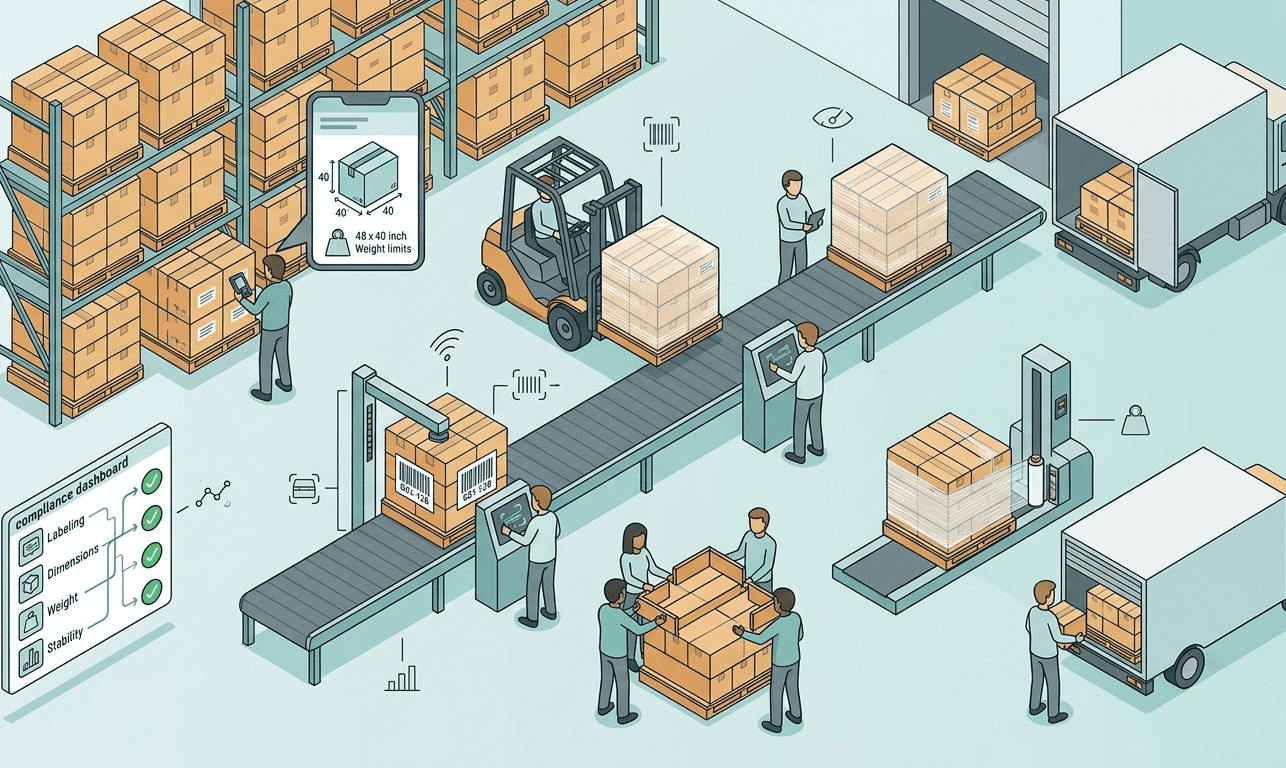
The GMA (Grocery Manufacturers Association) standard pallet is 48 inches by 40 inches. This is the baseline for nearly every major retailer in the United States. If your 3PL is building pallets on non-standard sizes without explicit retailer approval, you are asking for trouble.
Beyond dimensions, here are the retail pallet specifications that matter:
Pallet type: Most retailers require four-way entry, heat-treated (ISPM 15 compliant) wood pallets. Some accept plastic pallets for specific categories, but wood remains the default. Pallets must be in good condition with no broken boards, protruding nails, or visible contamination.
Weight limits: Most retailers cap pallet weight between 2,000 and 2,500 pounds, including the pallet itself. Your 3PL needs to weigh every pallet before it ships.
Height limits: Standard pallet height requirements typically fall between 48 and 60 inches total (pallet plus product). Going over means your shipment may not fit standard racking, which means rejection at the dock.
Overhang and underhang: Cases should not extend beyond the pallet edges (overhang) or sit too far inside the edges (underhang). Either condition creates instability and receiving issues. The general tolerance is one inch or less on any side.
If your products include beverages, the weight constraints become especially critical. Liquid products are heavy, and building pallets that meet both weight and height requirements simultaneously takes experience. Brands in this category should review the unique challenges covered in our guide on [beverage warehousing and fulfillment](https://shipdudes.com/blog/beverage-warehousing-and-fulfillment-complete-guide-for-liquid-products).
Pallet Building Requirements: Stacking, Wrapping, and Stability
How cases are arranged on a pallet matters as much as the pallet itself. Pallet building requirements dictate the stacking pattern, wrap specifications, and load stability standards.
Column stacking vs. interlocking: Column stacking (cases directly on top of each other) maximizes crush strength but can create instability. Interlocking (alternating case orientation per layer) improves stability but can compromise case integrity for heavier products. Your 3PL should know which method each retailer prefers and which your product can handle.
Stretch wrap standards: Most retailers require clear stretch wrap applied in a minimum number of revolutions (typically five wraps around the top and bottom, with full coverage in between). Some require specific gauge thickness. The wrap must secure the load to the pallet itself, not just hold the cases together.
Corner boards: For certain product categories, especially anything fragile or in glass packaging, corner boards are required. These vertical cardboard or plastic strips placed at each corner provide additional structural integrity. If your 3PL handles fragile items, they should already be following the protocols outlined in our piece on [fragile product fulfillment](https://shipdudes.com/blog/fragile-product-fulfillment-packaging-handling-and-damage-prevention-strategies).
Tier sheets: Slip sheets or tier sheets (flat cardboard sheets placed between layers) are required by many retailers, particularly for products with irregular case shapes. They distribute weight evenly and prevent cases from shifting during transit.
Labeling and Documentation: Where Most 3PLs Drop the Ball
You can build a perfect pallet and still get hit with chargebacks if the labeling is wrong. B2B shipping standards for labeling are incredibly specific, and they vary by retailer.
GS1-128 labels: Most major retailers require GS1-128 (formerly UCC-128) shipping labels on every pallet. These barcodes encode the SSCC (Serial Shipping Container Code), which ties your pallet to the retailer's ASN (Advanced Shipping Notice). If the barcode does not match the ASN, the shipment gets flagged.
Label placement: Labels must be placed on two adjacent sides of the pallet, typically four inches from the bottom of the outermost case. Misplaced labels cause scanning failures at receiving, which causes delays, which causes chargebacks.
ASN accuracy: The Advanced Shipping Notice must be transmitted via EDI before the shipment arrives. It must match the physical shipment exactly: same SKUs, same quantities, same pallet count. Any discrepancy triggers compliance violations.
This is why [EDI integration and retail distribution](https://shipdudes.com/blog/b2b-order-fulfillment-edi-integration-and-retail-distribution-essentials) capability is non-negotiable for any 3PL handling wholesale fulfillment. If your fulfillment partner cannot send clean EDI documents, you should not be trusting them with B2B orders.
Retailer-Specific Compliance: One Size Does Not Fit All
Here is where things get complicated. While there are general wholesale pallet requirements, each retailer layers on their own specifications. Walmart's requirements differ from Target's, which differ from Costco's, which differ from Amazon's retail program.
Some examples of retailer-specific variations:
- Walmart requires MABD (Must Arrive By Date) compliance and uses a point-based chargeback system called OTIF (On Time In Full)
- Target has specific case pack quantity requirements and preferred carrier routing
- Amazon Retail (not FBA) has its own set of packaging, labeling, and appointment scheduling rules
- Whole Foods has additional requirements around organic certification documentation and lot traceability
Your 3PL needs to maintain updated compliance guides for every retailer you sell into. These guides change frequently, sometimes quarterly, and missing an update can result in chargebacks on shipments that were compliant last month.
At ShipDudes, our B2B and retail distribution team maintains active compliance documentation for major retailers and updates routing guides as they change. This is part of our EDI-compliant wholesale fulfillment service, and it is the kind of operational detail that separates a real B2B fulfillment partner from a warehouse that just happens to ship pallets.
What to Ask Your 3PL Before Sending Wholesale Orders
If you are evaluating a 3PL for wholesale fulfillment compliance, here are the questions that matter:
1. Do you support GS1-128 labeling and automated ASN generation? If they hesitate, walk away.
2. Which retailers have you shipped to in the last 12 months? Ask for specific names and chargeback rates.
3. How do you stay current on routing guide changes? The answer should be a defined process, not "we check when needed."
4. What is your pallet QC process before shipment? They should be inspecting weight, height, wrap integrity, and label placement.
5. Can you handle mixed-SKU pallets? Some orders require multiple products on a single pallet with specific layer configurations. This is a skill, not a default.
Holding your fulfillment partner accountable on these standards should be part of your SLA. If you need a framework for that, check out our guide on [3PL SLA enforcement](https://shipdudes.com/blog/3pl-sla-enforcement-how-to-hold-fulfillment-partner-accountable-templates).
Also, make sure your billing is transparent. B2B fulfillment involves additional labor for pallet building, labeling, and documentation. Those costs should be clearly itemized, not buried. Our breakdown of [3PL billing audits](https://shipdudes.com/blog/3pl-billing-audit-how-to-spot-overcharges-and-hidden-fees) can help you spot hidden charges.
The Cost of Getting Wholesale Pallets Wrong
Let's be direct about the stakes. A single OTIF violation with Walmart can cost 3% of the COGS for that shipment. Repeated violations compound. Some brands have lost six figures in a single quarter from chargebacks alone.
Beyond the financial hit, compliance failures damage your vendor scorecard. Retailers track your performance over time, and a poor track record can lead to reduced shelf space, deprioritized purchase orders, or outright removal from the program.
This is not an area where "close enough" works. Your 3PL either meets wholesale pallet requirements consistently, or they cost you money every time a shipment goes out.
ShipDudes Handles B2B Shipping Standards So You Don't Have To
At ShipDudes, we built our B2B and retail distribution capabilities specifically for CPG brands selling into major retailers and wholesale channels. Our dual-coast warehouse network (Northern New Jersey and Las Vegas) means we can ship to retail DCs across the country with shorter transit times and lower freight costs. Our team is entirely US-based, so when a routing guide changes or a shipment question comes up, you are talking to someone who actually handles your pallets.
We manage EDI compliance, GS1-128 labeling, ASN transmission, and retailer-specific pallet building for brands in beauty, supplements, food, beverages, pet products, and general CPG. If you are scaling into wholesale or struggling with chargebacks from your current setup, we should talk.
[Book a call with ShipDudes](https://shipdudes.com/book-a-call) and let's make sure your wholesale fulfillment is built to pass every compliance check, every time.
Ready to Simplify Your Fulfillment?
Let's build a custom pricing model for your brand. No contracts required to start the conversation.