Expiration Date Management: FIFO Fulfillment for CPG Brands

Michael DeSarno
8 min read
Inventory Management
Share
KEY TAKEAWAYS
• FIFO fulfillment requires expiration date capture at receiving, bin-level lot separation, and WMS-enforced pick logic to prevent costly write-offs.
• Different sales channels (Amazon FBA, retail, DTC) require different minimum shelf life thresholds enforced automatically at the pick level.
• A 5% expiration loss rate on $3M in revenue equals $150K in wasted inventory per year.
• ShipDudes enforces FIFO as standard across dual-coast warehouses with channel-specific shelf life rules and proactive aging alerts.
Last Updated:
If you sell anything with a shelf life (supplements, food, beverages, beauty products, pet treats), expiration date management fulfillment is not optional. It is the difference between a growing brand and one bleeding cash from write-offs, chargebacks, and angry customers posting about expired products on social media.
Here is the uncomfortable truth: most 3PLs treat expiration dates as an afterthought. They receive your inventory, shove it on a shelf, and pick whatever is closest when an order comes in. That works fine for phone cases. It is a disaster for CPG brands.
Let's break down what proper expiration date management looks like at the warehouse level, why FIFO fulfillment is non-negotiable, and how to evaluate whether your current (or future) 3PL can actually handle it.
Why Expiration Date Management Is a Revenue Problem, Not Just an Ops Problem
Most founders think about expiration dates in terms of compliance. "We need to track it because the FDA says so." That is true, but it misses the bigger picture.
Expired or short-dated inventory creates a cascade of problems that hit your bottom line directly:
- Dead stock write-offs. Every unit that expires on the shelf is money you already spent on ingredients, manufacturing, packaging, and inbound freight. Gone.
- Customer complaints and refunds. A customer who receives a product expiring in two weeks (or already expired) is not coming back. They are requesting a refund, and they might leave a review that costs you dozens of future sales.
- Retail chargebacks. If you sell into retail through B2B distribution, retailers will fine you for delivering short-dated products. These chargebacks can be brutal.
- Channel suspension risk. Amazon, in particular, has strict policies around expiration dates. Send FBA inventory that is too close to expiration and you risk having your listings suppressed or your account flagged.
The financial impact compounds fast. For a supplement brand doing $3M in annual revenue with 18-month shelf life products, even a 5% expiration loss rate means $150K in wasted inventory per year. That is not a rounding error. That is your next product launch.
What FIFO Fulfillment Actually Means (and Why Most Warehouses Fail at It)
FIFO stands for First In, First Out. The concept is simple: the oldest inventory gets shipped first. But executing FIFO fulfillment consistently at scale requires systems, discipline, and warehouse processes that most operations lack.
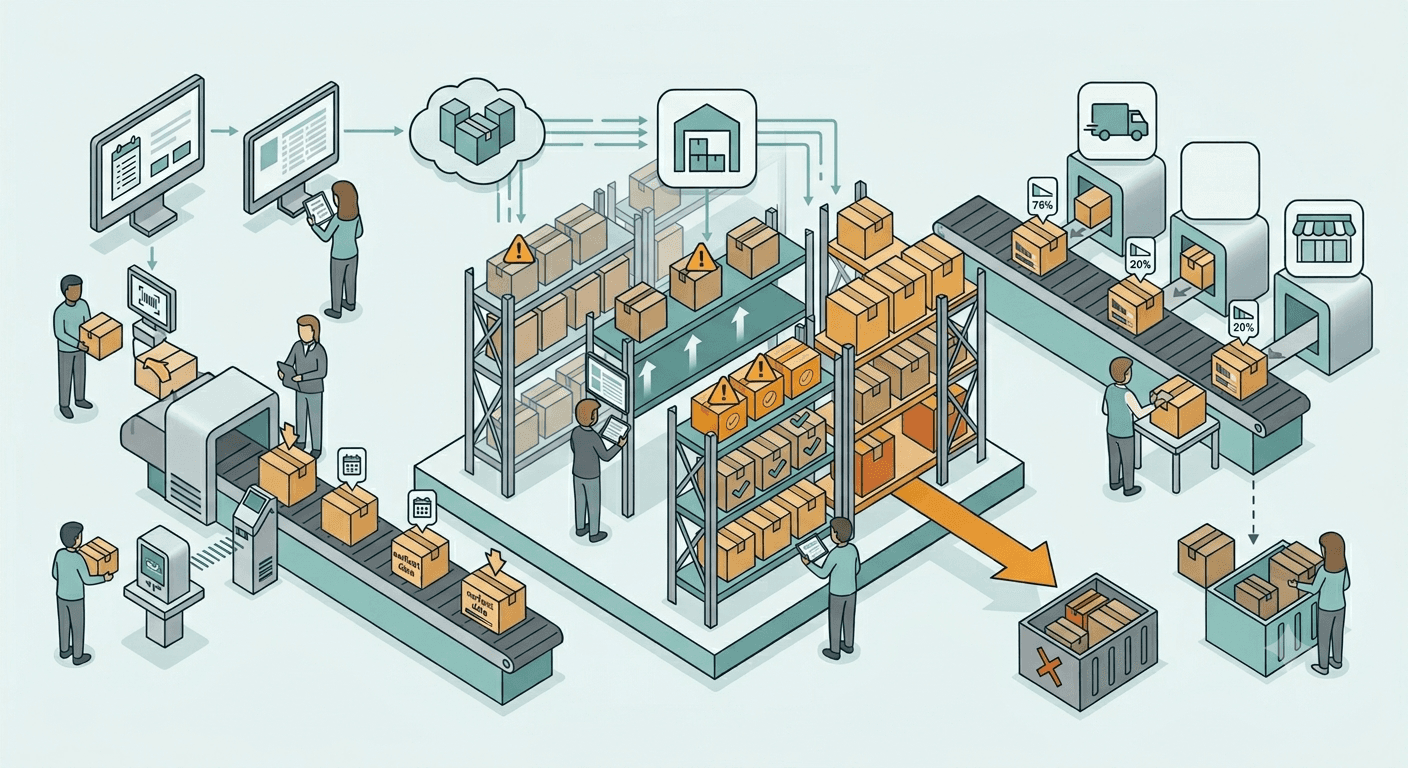
True FIFO is not just about picking the oldest pallet. It requires:
1. Expiration date capture at receiving. Every inbound shipment must have its expiration dates (or best-by dates) recorded at the SKU and lot level during the [warehouse receiving process](https://shipdudes.com/blog/warehouse-receiving-process). If your 3PL is not logging this information the moment product hits the dock, FIFO is impossible.
2. Bin-level inventory organization. Products need to be stored in a way that separates lots by expiration date. This means warehouse management systems (WMS) that assign specific bin locations based on date codes, not just SKU numbers.
3. Pick logic that enforces FIFO. The WMS must direct pickers to the correct bin, meaning the one with the earliest expiration date, for every single order. Relying on pickers to manually check dates is a recipe for errors.
4. Automated alerts for approaching expiration. The system should flag inventory that is approaching a threshold (for example, 90 days before expiration) so you can take action: run a promotion, donate it, or pull it from active inventory.
At ShipDudes, FIFO is not a premium add-on. It is built into the standard fulfillment workflow for every CPG brand we serve. Our WMS captures expiration dates at receiving, assigns lot-specific bin locations, and enforces FIFO pick logic automatically. The brand gets real-time visibility into inventory aging without having to ask.
Product Expiration Tracking: The Technical Requirements
Let's get specific about what product expiration tracking looks like inside a well-run fulfillment operation.
Receiving and Data Capture
When a shipment arrives, every case or pallet needs to be inspected for date codes. This data gets entered into the WMS tied to the specific lot and SKU. Good operations also capture the lot or batch number alongside the expiration date, which ties into [lot tracking fulfillment and recall traceability](https://shipdudes.com/blog/lot-tracking-fulfillment-cpg-brand-recall-traceability-requirements).
If your 3PL cannot tell you, at any given moment, exactly how many units of each SKU exist at each expiration date, they are not tracking properly.
Inventory Visibility and Reporting
You should have access to a dashboard or report that shows:
- Total units per SKU broken down by expiration date
- Units approaching your minimum shelf life threshold
- Units that have passed the threshold and need to be quarantined
- Historical data on expiration-related waste
This level of visibility feeds directly into [inventory management for DTC brands](https://shipdudes.com/blog/inventory-management-for-dtc-brands). When you know exactly what is aging and how fast it is moving, you can make smarter purchasing decisions.
Quarantine and Disposal Protocols
What happens when product expires? A proper shelf life management 3PL has clear protocols: expired inventory is quarantined (physically separated and flagged in the system), and the brand is notified. From there, you decide if it gets destroyed, donated, or returned. The key is that expired product never accidentally ends up in a customer's order.
FIFO Across Channels: The Omnichannel Complexity
Here is where things get tricky for growing CPG brands. You are not just shipping DTC orders from Shopify. You are fulfilling Amazon FBA replenishment, retail purchase orders, subscription boxes, and maybe wholesale through Faire.
Each channel has different shelf life requirements:
- Amazon FBA requires products to have a remaining shelf life of at least 90 days upon arrival at their fulfillment centers (some categories require more). If you are prepping [Amazon FBA shipments](https://shipdudes.com/blog/amazon-fba-prep), your 3PL needs to check dates before packing.
- Retail buyers often require 60 to 75 percent of remaining shelf life at delivery. Send short-dated product and expect a chargeback. Proper [B2B order fulfillment](https://shipdudes.com/blog/b2b-order-fulfillment-edi-integration-and-retail-distribution-essentials) accounts for these requirements.
- DTC orders are more flexible, but customers still expect reasonable shelf life. Shipping a product that expires in 30 days is not a great customer experience.
- Subscription boxes add another layer, since [subscription box fulfillment](https://shipdudes.com/blog/subscription-box-fulfillment-complete-guide-for-recurring-revenue-brands) requires planning inventory across recurring shipment cycles.
When you are running [omnichannel fulfillment](https://shipdudes.com/blog/omnichannel-fulfillment), your 3PL needs to apply different shelf life rules to different channels automatically. At ShipDudes, our system lets brands set channel-specific minimum shelf life thresholds. So your Amazon FBA prep might require 120 days remaining, your retail POs might require 9 months, and your DTC orders might accept anything with 30 or more days. The WMS enforces these rules at the pick level.
Perishable Goods Fulfillment: Category-Specific Considerations
Not all expiration management is the same. The complexity varies by product category.
Supplements typically have shelf lives of 18 to 24 months, but [supplement fulfillment](https://shipdudes.com/blog/supplement-fulfillment-fda-compliance-lot-tracking-and-expiration-management) also involves FDA compliance, lot tracking, and sometimes temperature sensitivity. FIFO is critical because supplement brands often produce in large batches that can sit in warehouses for months.
Beverages present weight and fragility challenges on top of shelf life. [Beverage fulfillment](https://shipdudes.com/blog/beverage-fulfillment-challenges-glass-liquid-restrictions-and-shipping-solutions) requires careful handling, and some products (especially those without preservatives) have shorter windows.
Beauty products may have shorter shelf lives once opened, but the manufactured date and expiration still need tracking. [Beauty product fulfillment](https://shipdudes.com/blog/beauty-product-fulfillment) at scale demands the same FIFO rigor.
Shelf-stable food varies widely. Some products have two-year shelf lives. Others, especially clean-label products with fewer preservatives, may expire within 6 to 12 months. [Food fulfillment center requirements](https://shipdudes.com/blog/food-fulfillment-center-requirements-fda-compliance-and-safe-storage) include FDA-compliant storage conditions alongside expiration tracking.
For any of these categories, the [lot code tracking requirements for FDA recall preparedness](https://shipdudes.com/blog/lot-code-tracking-requirements-fda-recall-preparedness-cpg-brands) add another layer. If there is ever a recall, you need to know exactly which lot codes went to which customers, which brings expiration tracking and lot tracking together into one system.
How to Evaluate a 3PL's Expiration Date Management
If you are shopping for a shelf life management 3PL, here are the questions to ask during your evaluation:
1. Do you capture expiration dates at receiving, and is it mandatory? If it is optional or "available upon request," walk away.
2. Does your WMS enforce FIFO at the pick level, or is it a manual process? System-enforced FIFO is the only reliable method.
3. Can I set different minimum shelf life thresholds per channel? This is essential for omnichannel brands.
4. What alerts or reports do I get on aging inventory? You need proactive notifications, not surprises.
5. What is your process when product expires in the warehouse? There should be a clear quarantine and notification protocol.
6. Can you show me a sample inventory aging report? If they cannot produce one, their tracking is not real.
For a deeper look at what metrics matter when evaluating fulfillment partners, check out [3PL performance metrics that actually matter](https://shipdudes.com/blog/3pl-performance-metrics-that-actually-matter-kpis-beyond-order-accuracy). And if you want to understand how inventory aging analysis can turn slow-moving stock into recovered revenue before it expires, read our guide on [inventory aging analysis](https://shipdudes.com/blog/inventory-aging-analysis-liquidate-dead-stock-cash-flow).
Preventing Expiration Waste Before It Starts
The best expiration date management fulfillment strategy is proactive, not reactive. Here is what that looks like in practice:
- Align production schedules with sell-through velocity. Use historical data from your 3PL to avoid over-ordering.
- Set aggressive alert thresholds. Do not wait until 30 days before expiration to act. Set alerts at 90, 120, or even 180 days depending on your product.
- Plan promotions around aging inventory. If you see a batch approaching your comfort zone, run a flash sale or bundle it. Your 3PL should support [kitting and assembly](https://shipdudes.com/blog/kitting-and-assembly-services) for these kinds of pivot moves.
- Use dual-coast distribution wisely. With [fulfillment centers on both coasts](https://shipdudes.com/blog/fulfillment-centers-east-and-west-coast), you can split inventory strategically so products move faster through both locations rather than sitting in one.
FAQ: Expiration Date Management Fulfillment
What is FIFO fulfillment and why does it matter for CPG brands?
FIFO (First In, First Out) fulfillment means the oldest inventory is always shipped first. For CPG brands with expiration dates, FIFO prevents products from aging out on warehouse shelves, reducing waste, customer complaints, and financial losses from expired inventory.
How does a 3PL track expiration dates?
A qualified 3PL captures expiration dates during the warehouse receiving process and stores them in the WMS at the SKU and lot level. The system then uses this data to enforce FIFO pick logic, generate aging reports, and send alerts when products approach minimum shelf life thresholds.
What happens if expired products are shipped to customers?
Shipping expired products can result in refund requests, negative reviews, potential regulatory issues, and loss of customer trust. On Amazon, it can lead to listing suppression or account penalties. In retail, it triggers chargebacks. A strong expiration date management fulfillment system prevents this from happening.
Can a 3PL apply different shelf life rules for different sales channels?
Yes. Advanced 3PLs like ShipDudes allow brands to set channel-specific minimum shelf life thresholds. For example, Amazon FBA prep might require 120 days remaining while DTC orders accept 30 days. The WMS enforces these rules automatically during picking.
What industries benefit most from FIFO fulfillment?
Any CPG brand selling products with expiration or best-by dates benefits from FIFO fulfillment. This includes supplements, shelf-stable food, beverages, beauty and skincare products, and pet food or treats.
Stop Losing Money to Expired Inventory
If you are a CPG brand dealing with expiration dates, your fulfillment partner's ability to manage shelf life is not a nice-to-have. It is directly tied to your margins, your customer experience, and your ability to sell across channels without getting burned by chargebacks or expired write-offs.
ShipDudes was built by eCommerce operators who understand these problems firsthand. Our dual-coast warehouses in Northern New Jersey and Las Vegas run FIFO as a standard process, with expiration tracking, lot-level visibility, channel-specific shelf life rules, and proactive aging alerts baked into every CPG brand's workflow.
If you are ready to stop guessing and start managing expiration dates like a real operation, [book a call with ShipDudes](https://shipdudes.com/book-a-call) and let's walk through how we would handle your specific product and channel mix.




Ready to Simplify Your Fulfillment?
Let's build a custom pricing model for your brand. No contracts required to start the conversation.