Warehouse Automation ROI: When Robotics Actually Pay Off in 3PL Operations

Michael DeSarno
8 min read
Fulfillment Operations
Share
KEY TAKEAWAYS
• Software automation (WMS, inventory sync, order routing) pays back in weeks; physical robotics take 3 to 5 years.
• Warehouse robotics ROI is weak below 1,000 orders per day or with highly variable SKU catalogs.
• Growing CPG brands get better ROI partnering with a 3PL that spreads automation costs across its client base.
• ShipDudes runs 4 warehouses on 2 coasts with 75+ integrations and 7-day processing, no robotics marketing hype required.
Last Updated:
Every logistics trade show, every supply chain LinkedIn thread, every VC pitch deck tells you the same story: robots are the future of fulfillment. And they're not wrong. But there's a massive gap between "automation is the future" and "automation will generate positive ROI for your specific operation right now."
As a brand evaluating 3PL partners or considering your own warehouse investments, you need to understand warehouse automation ROI at a practical level. Not the glossy case studies from companies processing millions of orders per day, but the real math that applies to growing CPG brands shipping hundreds or thousands of orders daily.
Let's break down when warehouse robotics fulfillment actually pays for itself, when it doesn't, and what smart brands should actually care about when choosing a fulfillment partner.
The Current State of Warehouse Automation
Warehouse automation exists on a spectrum. On one end, you have simple barcode scanners and conveyor belts. On the other, fully autonomous mobile robots, robotic picking arms, and AI-driven sortation systems. Most 3PL automation warehouse setups fall somewhere in the middle.
Here's what the landscape actually looks like in 2024 and 2025:
- Goods-to-person (GTP) systems like AutoStore or Locus Robotics bring inventory to pickers rather than having people walk aisles. These can cut pick times by 50% or more.
- Automated sortation uses conveyors and divert systems to route orders to packing stations. Great for high-volume, single-SKU operations.
- Robotic picking arms handle item-level picks. Still limited by product variability (great for uniform boxes, terrible for oddly shaped beauty products).
- Autonomous mobile robots (AMRs) move inventory around the warehouse floor, reducing the walking that accounts for 60% or more of a picker's shift.
- Software automation includes warehouse management systems (WMS), automated inventory sync, and intelligent slotting algorithms.
The key insight most people miss: software automation delivers a dramatically faster payback than physical robotics. A WMS upgrade might pay for itself in weeks. A fleet of AMRs might take three to five years.
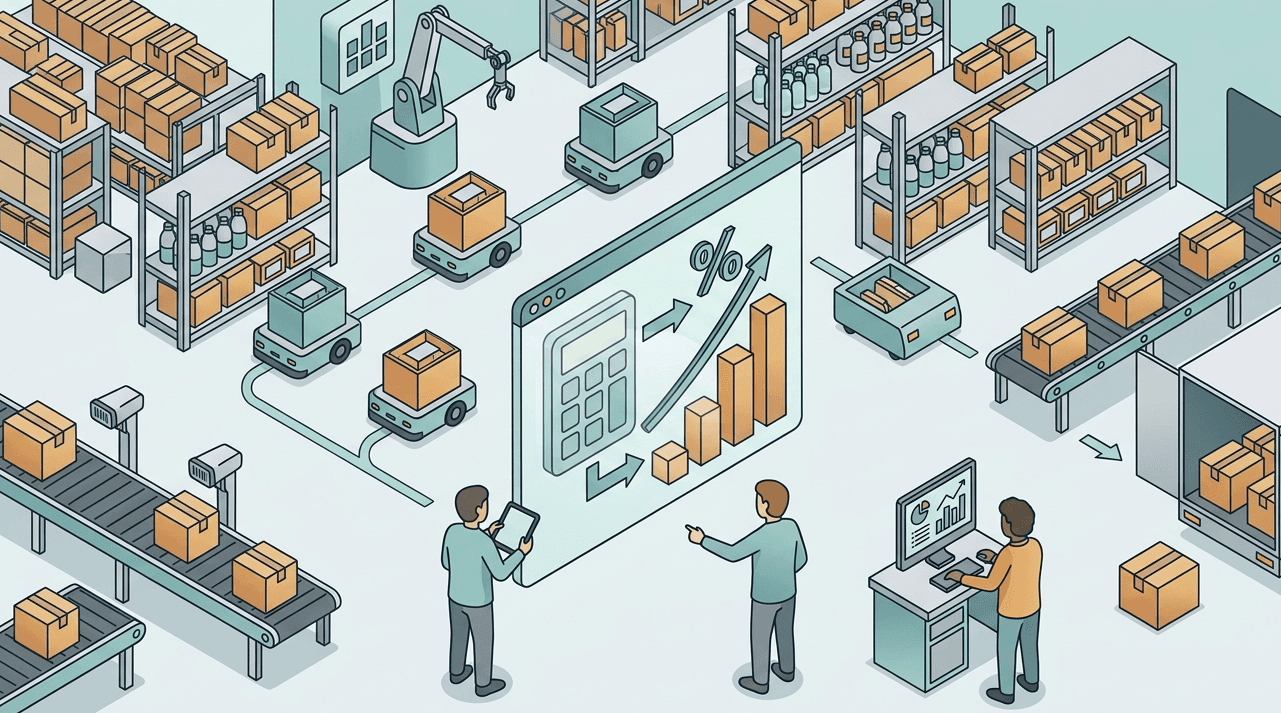
How to Calculate Warehouse Automation ROI
The basic formula for warehouse automation ROI is straightforward. The complexity is in getting honest numbers.
ROI = (Net Benefits from Automation / Total Cost of Automation) x 100
But you need to account for both direct and indirect factors.
Direct Cost Savings
- Labor reduction: This is the biggest lever. If automation reduces your pick and pack labor by 30%, calculate that against fully loaded labor costs (wages, benefits, training, turnover).
- Error reduction: Every mispick costs you. Returns processing, reshipping, customer service time, and brand damage. Automated fulfillment systems typically achieve 99.9%+ accuracy versus 97 to 99% for manual operations.
- Throughput increase: Same square footage processing more orders means your cost per order drops. This matters when you're evaluating a [3PL's performance metrics](https://shipdudes.com/blog/3pl-performance-metrics-that-actually-matter-kpis-beyond-order-accuracy).
- Space utilization: GTP systems can increase storage density by 2 to 4x, which defers the cost of leasing additional warehouse space.
Direct Costs
- Capital expenditure: Hardware, installation, integration. A basic AMR fleet for a mid-size warehouse can run $500K to $2M. Full AutoStore implementations start well above that.
- Ongoing maintenance: Robots break. Budget 5 to 10% of hardware cost annually for maintenance.
- Software licensing: Many automated fulfillment systems charge ongoing SaaS fees.
- Integration costs: Getting robots to talk to your WMS, OMS, and [multi-channel inventory sync](https://shipdudes.com/blog/multi-channel-inventory-sync-how-to-prevent-overselling-across-shopify-amazon-and-tiktok-shop) tools is never as simple as vendors claim.
- Training and change management: Your team needs to learn new workflows.
Indirect Factors (Often Overlooked)
- Flexibility cost: Highly automated systems are optimized for specific workflows. If your product mix changes (new SKUs, different packaging, seasonal kitting), reconfiguring automation is expensive. Compare that to the flexibility of a well-trained human team handling [complex kitting at scale](https://shipdudes.com/blog/multi-sku-bundle-fulfillment-complex-kitting-at-scale).
- Downtime risk: When a robot goes down, the line stops. When a person calls in sick, someone else covers. Redundancy in automated systems is costly.
- Opportunity cost: That $1M in automation investment could fund inventory, marketing, or geographic expansion. Brands expanding to [dual-coast fulfillment](https://shipdudes.com/blog/fulfillment-centers-east-and-west-coast) often get faster ROI from strategic warehouse placement than from robotics.
When Automation ROI Is Strong
Automation makes the most financial sense under specific conditions. If your operation checks multiple boxes below, the payback period shortens significantly.
High order volume with consistent patterns. If you're processing 10,000+ orders per day with relatively predictable volume, automation thrives. The fixed costs get spread across enough orders to make unit economics work. Brands dealing with [flash sale fulfillment](https://shipdudes.com/blog/flash-sale-fulfillment-handling-sudden-order-volume-spikes) spikes, on the other hand, need flexible capacity more than fixed automation.
Simple, uniform product profiles. Automation works best with standardized products. A supplement brand shipping bottles of similar size and weight is a great candidate. A beauty brand with 200 SKUs ranging from tiny lip glosses to large gift sets is harder to automate cost-effectively. If you're running a [beauty product fulfillment](https://shipdudes.com/blog/beauty-product-fulfillment) operation, product variety matters.
Tight labor markets. In regions where warehouse labor is scarce or expensive, automation becomes a necessity rather than an optimization. This is a market reality, not just an ROI calculation.
High error costs. If your products are regulated (supplements, food, beverages), mispicks and mislabeling carry outsized costs. Automated systems with built-in [lot tracking and traceability](https://shipdudes.com/blog/lot-tracking-fulfillment-cpg-brand-recall-traceability-requirements) can pay for themselves through compliance alone.
Multi-year lease commitments. Automation ROI requires time. If you're locked into a warehouse lease for five or more years, you have the runway to recoup the investment.
When Automation ROI Is Weak (or Negative)
Here's where the honest conversation happens. Many brands and 3PLs invest in automation too early or for the wrong reasons.
Order volumes under 1,000 per day. The math rarely works. Your fixed automation costs get divided across too few orders, making your cost per order higher than a well-run manual operation. For brands at this stage, the priority should be finding a strong [pick and pack fulfillment](https://shipdudes.com/blog/pick-and-pack-fulfillment) partner with efficient manual processes.
Highly variable product catalogs. If you're constantly adding SKUs, running limited editions, or managing [SKU proliferation](https://shipdudes.com/blog/sku-proliferation-management-how-to-handle-complex-product-catalogs), automation struggles to keep up. Every new product type potentially requires recalibration.
Seasonal businesses with dramatic volume swings. If 60% of your revenue comes in Q4, you're paying for automation capacity that sits idle for nine months. A better approach is partnering with a 3PL that can scale labor for [peak season](https://shipdudes.com/blog/peak-season-fulfillment-strategy) and maintain lean operations the rest of the year.
Rapid growth with uncertain trajectories. Startups and early-stage brands should not be investing in warehouse robotics. The operational model will change too frequently. Focus on finding a 3PL partner that already has the infrastructure, and let them manage the automation investment.
Kitting-heavy operations. If a significant portion of your orders involve custom bundles, subscription boxes, or assembled kits, human hands are still faster and more flexible. [Kitting and assembly services](https://shipdudes.com/blog/kitting-and-assembly-services) require adaptability that most current robotics can't match.
The Smarter Play: Leveraging Your 3PL's Automation
Here's what most growing CPG brands miss. You don't need to invest in automation yourself. You need to partner with a 3PL that has already made the right automation investments and spreads those costs across their client base.
This is the core advantage of outsourcing to a 3PL automation warehouse. The 3PL invests in the technology, amortizes the cost across dozens of clients, and you benefit from lower per-order costs without the capital risk.
At ShipDudes, for example, the focus is on the automation that delivers the fastest, most reliable ROI for clients: advanced WMS integration with [75+ platform connections](https://shipdudes.com/blog/3pl-technology-integration-apis-webhooks-and-real-time-data-sync), intelligent inventory management across [dual-coast facilities](https://shipdudes.com/blog/nationwide-3pl-fulfillment-why-a-two-coast-setup-beats-a-single-warehouse) in New Jersey and Las Vegas, and process optimization that keeps accuracy high and costs low.
The automation that matters most for growing brands is often not physical robots. It's the software layer: real-time [inventory management](https://shipdudes.com/blog/3pl-inventory-management-systems-real-time-visibility-and-control), automated order routing, seamless [API integrations](https://shipdudes.com/blog/3pl-integration-api-documentation-technical-requirements-seamless-connectivity), and intelligent [inventory allocation across channels](https://shipdudes.com/blog/inventory-allocation-strategies-multi-channel-brands-prevent-stock-conflicts). These systems deliver immediate ROI without the risk profile of heavy hardware investments.
What to Ask Your 3PL About Their Automation Strategy
When evaluating 3PL partners, don't just ask "do you have robots?" Ask better questions:
1. What's your order accuracy rate, and how do you achieve it? A 3PL hitting 99.9% with smart process design and targeted automation is more impressive than one hitting 99.5% with millions in robotics.
2. How do you handle volume surges? Can they [stress-test fulfillment](https://shipdudes.com/blog/3pl-scalability-testing-how-to-stress-test-your-fulfillment-partner-before-peak-season) capacity, or does automation create a hard ceiling?
3. What's your technology integration approach? Real-time data sync matters more than physical automation for most brands. A 3PL with robust [omnichannel fulfillment](https://shipdudes.com/blog/omnichannel-fulfillment) capabilities is providing automation where it counts.
4. How do you handle exceptions? Returns, damaged inventory, custom requests. These are the tasks that expose the limits of automation. Make sure your 3PL has strong [returns processing](https://shipdudes.com/blog/returns-processing-automation-how-smart-3pls-turn-returns-into-revenue-recovery) and [quality control](https://shipdudes.com/blog/3pl-quality-control-systems-how-to-prevent-order-errors-before-they-reach-customers) workflows.
5. Where is the team? Automated systems still require human oversight. A [US-based fulfillment team](https://shipdudes.com/blog/the-real-cost-of-3pl-overseas-support-why-us-based-teams-matter-for-your-brand) can troubleshoot faster and communicate more effectively when issues arise.
The Bottom Line on Warehouse Automation ROI
Warehouse automation ROI is real, but it's not universal. The brands that win are the ones who match the right level of automation to their actual operational needs, not the ones who chase the flashiest technology.
For most growing CPG brands shipping between 100 and 5,000 orders per day, the highest ROI comes from partnering with a 3PL that has already invested in the right mix of technology and process optimization. You get the benefits of automation without the capital risk, the maintenance headaches, or the flexibility constraints.
ShipDudes operates four warehouse facilities across two coasts, integrates with 75+ platforms, and processes orders seven days a week with an all in-house, US-based team. The focus is always on delivering results through the right combination of technology and operational excellence, not on deploying robots for the sake of a good marketing story.
If you're evaluating your fulfillment strategy and want to understand what automation actually matters for your brand's growth stage, [book a call with ShipDudes](https://shipdudes.com/book-a-call). We'll walk through your order profile, your product mix, and your growth plans to build a fulfillment approach that delivers real ROI.
Frequently Asked Questions
What is a good ROI for warehouse automation?
A strong warehouse automation ROI typically means recouping your investment within 18 to 36 months. For physical robotics, payback periods of three to five years are common. Software automation (WMS upgrades, integration platforms, inventory sync tools) often delivers ROI within months. The "good" threshold depends on your order volume, labor costs, and how long you plan to operate in the same facility.
Do small eCommerce brands need warehouse automation?
Most small eCommerce brands (under 1,000 orders per day) don't need to invest directly in warehouse robotics. The capital costs are too high relative to order volume. Instead, partnering with a 3PL that has already built automated fulfillment systems into their operations lets you benefit from automation without the investment risk. Focus your capital on inventory, marketing, and growth.
What types of warehouse automation have the fastest payback?
Software automation delivers the fastest payback in nearly every scenario. This includes warehouse management systems, automated order routing, real-time inventory synchronization across sales channels, and API-based platform integrations. Among physical automation, conveyor-based sortation and barcode/scan verification systems tend to pay back faster than robotics because they cost less and address high-impact accuracy issues.
How does 3PL automation benefit brands compared to in-house automation?
When a 3PL invests in automation, the cost is distributed across their entire client base. This means you get access to advanced fulfillment technology at a fraction of what it would cost to build and maintain yourself. You also avoid the operational burden of maintaining equipment, hiring specialized technicians, and managing technology upgrades. A 3PL like ShipDudes absorbs those complexities while passing the efficiency benefits through to clients.
Can automation handle complex kitting and subscription box fulfillment?
Current automation handles simple, repetitive kitting well but struggles with complex or frequently changing configurations. If your operation involves custom bundles, subscription boxes with rotating products, or multi-SKU assemblies, human-driven workflows are still more flexible and cost-effective. The best approach is using automation for inventory management and order routing while keeping kitting and assembly in skilled human hands.
Ready to Simplify Your Fulfillment?
Let's build a custom pricing model for your brand. No contracts required to start the conversation.