Co-Packing vs 3PL Assembly: Which Model Scales Better for CPG Brands?

Michael DeSarno
8 min read
Industry Guides
Share
KEY TAKEAWAYS
• A 3PL API integration must cover order management, real-time inventory sync, shipment tracking, and returns endpoints to prevent data drift and overselling.
• Shopify 3PL API connections use webhooks and REST calls; verify your 3PL supports the latest API version, multi-location inventory, and Shopify Plus features.
• Integration testing should include edge cases, error handling, volume stress tests, and webhook reliability, not just a few test orders.
• ShipDudes supports 75+ native platform integrations with US-based support across 2 NJ and 2 Las Vegas warehouses.
Last Updated:
If you run a CPG brand, at some point you will hit a wall where your current fulfillment setup stops working. Maybe you are assembling variety packs in your garage. Maybe your co-packer has a 10,000-unit minimum that does not make sense for a new SKU launch. That is when the co-packing vs 3PL question becomes very real.
Here is the thing: most founders conflate these two models because both involve "someone else handling your product." But the differences between a co-packer and a 3PL with assembly capabilities are massive, and choosing the wrong one can lock you into a model that breaks the moment you try to scale.
Let us break down exactly what each model does, where each excels, and why most growing CPG brands find that a 3PL with kitting and assembly services is the more scalable path.
What Is Co-Packing (Contract Packaging)?
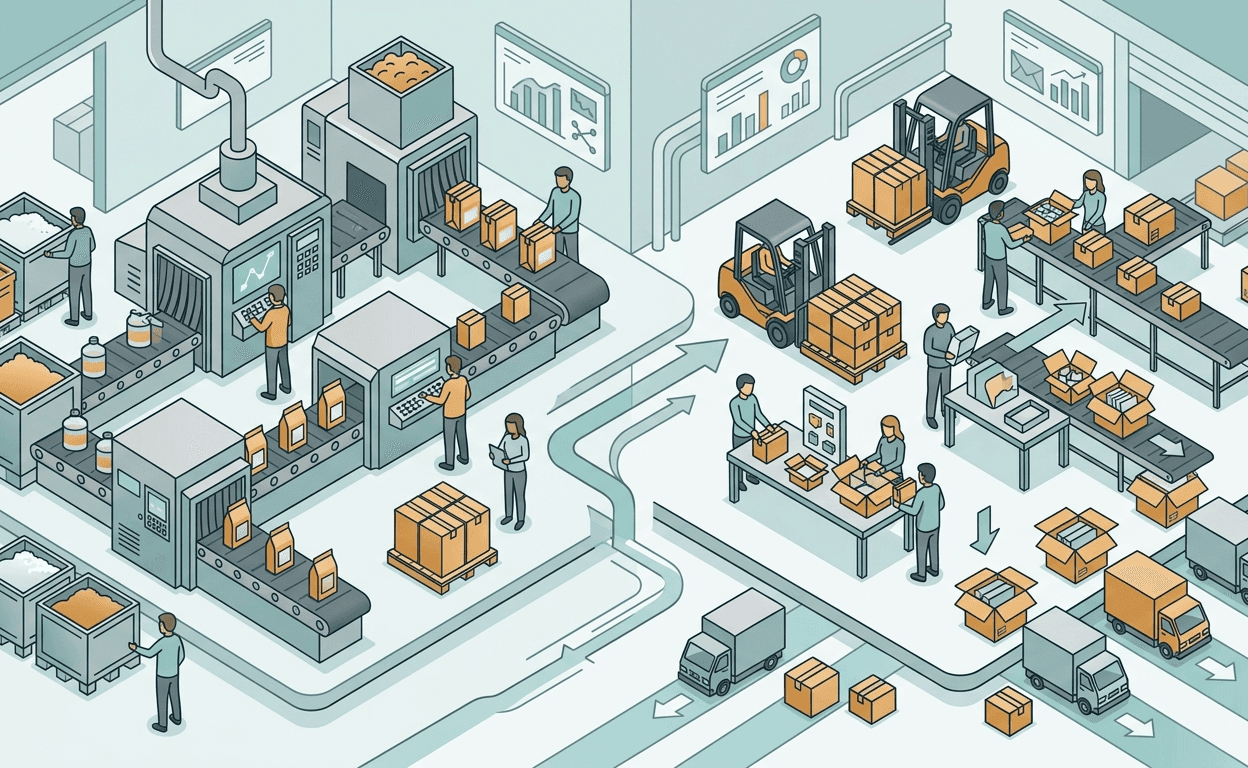
A co-packer, or contract packager, is a facility that takes raw or semi-finished goods and packages them into their final retail-ready form. Think of it this way: a co-packer takes bulk powder and puts it into individual supplement pouches, or takes loose snack bars and packages them into retail display boxes.
Co-packers typically operate in the manufacturing layer of your supply chain. Their core competencies include:
Filling, sealing, and labeling products
Creating retail-ready packaging from bulk goods
Running production lines with specific equipment (bottling lines, blister pack machines, shrink wrap tunnels)
Meeting FDA and GMP requirements for food, beverage, and supplement production
Contract packaging makes sense when your product literally needs to be manufactured or transformed before it can be sold. If you are producing a beverage that needs to be bottled, a co-packer with a bottling line is non-negotiable.
What Is 3PL Assembly?
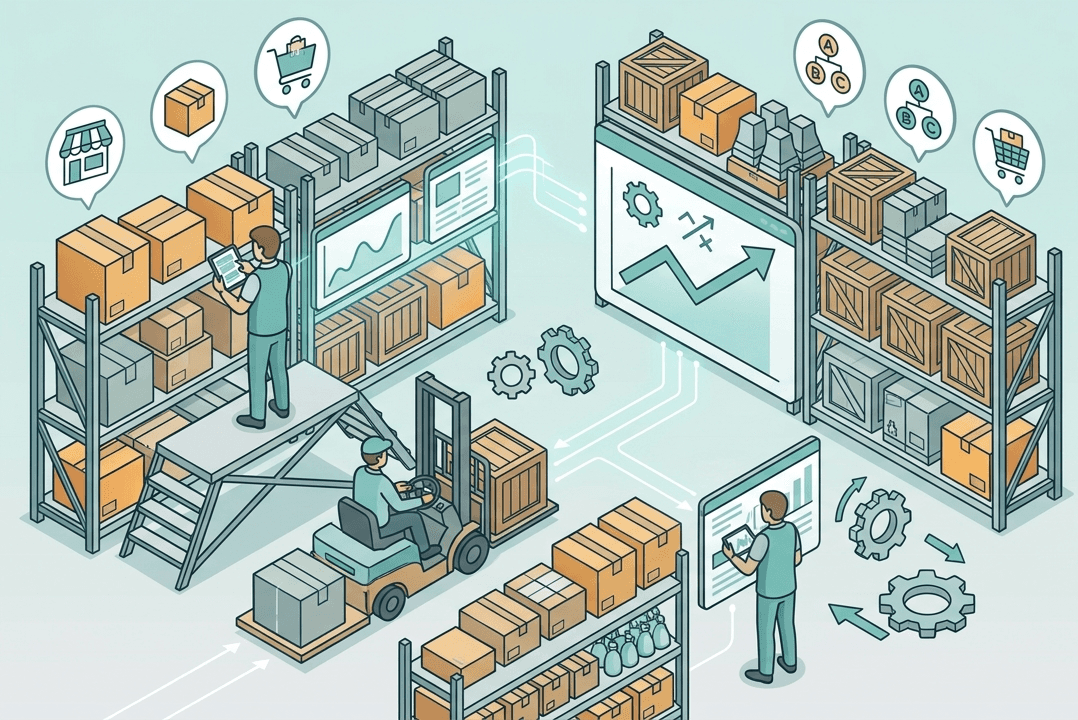
A 3PL (third-party logistics provider) with assembly capabilities handles the post-manufacturing side. Your product already exists in its finished form. The 3PL receives it, stores it, and then picks, packs, kits, assembles, and ships it to your customers or retail partners.
3PL assembly services, often called kitting and assembly, include:
Building variety packs and bundles from individual SKUs
Assembling subscription boxes with rotating product mixes
Inserting promotional materials, samples, or marketing collateral
Labeling and relabeling for different sales channels
Preparing products for Amazon FBA or retail distribution
Handling B2B retail distribution with EDI compliance
The key difference: a 3PL works with finished goods. A co-packer works with unfinished goods.
Co-Packer vs 3PL: Side-by-Side Comparison
Factor | Co-Packer | 3PL with Assembly |
|---|---|---|
Primary Function | Manufacturing and packaging raw/bulk goods | Storing, assembling, and shipping finished goods |
Minimum Order Quantities | Typically high (5,000 to 50,000+ units per run) | Usually flexible, often no minimums |
Lead Times | Weeks to months (production scheduling) | Days (inventory already on hand) |
Channel Flexibility | Single output format per run | Multi-channel from the same inventory pool |
SKU Agility | Low (retooling production lines is costly) | High (reconfigure bundles on the fly) |
DTC Fulfillment | Not included (separate partner needed) | Built-in pick and pack fulfillment |
Retail/B2B Distribution | Sometimes, but limited | Full EDI-compliant distribution |
Technology Integration | Minimal (ERP-focused) | 75+ eCommerce platform integrations |
Scalability Model | Scale through larger production runs | Scale through order volume and channel expansion |
Where Co-Packing Falls Short for Growing Brands
Co-packers are essential for certain functions. Nobody is arguing that you should skip the bottling line. But here is where CPG brands run into problems when they lean too heavily on the co-packing model.
High minimums kill experimentation. Want to test a new flavor in a 500-unit run? Most co-packers will not touch it. Their equipment is built for volume, and changeover costs make small batches economically painful. This is the exact problem we explored in our piece on small batch fulfillment and why minimum order requirements can strangle growing brands.
Long lead times slow your reaction speed. Co-packing runs are scheduled weeks or months out. If a product goes viral on TikTok and you need to ship 5,000 variety packs by Friday, your co-packer is not going to pivot their production schedule for you.
No direct fulfillment capability. A co-packer produces your product. Then what? You still need someone to store it, pick individual orders, pack them, and ship them to customers. That means managing a separate 3PL relationship on top of your co-packer, adding complexity and cost to your supply chain.
Limited channel flexibility. Co-packers produce in batches with a single configuration. If you need the same product packaged differently for Amazon, Shopify, and Faire, you are looking at separate production runs for each, or finding a downstream partner to handle that reconfiguration.
Why 3PL Assembly Scales Better for Most CPG Brands
For the majority of CPG brands (especially those selling beauty, supplements, pet products, and shelf-stable food), the product is already manufactured when it arrives at the warehouse. The real operational challenge is not production. It is getting the right product, in the right configuration, to the right customer, through the right channel, on time.
That is exactly what a 3PL with strong assembly capabilities solves.
Omnichannel from day one. A 3PL like ShipDudes can ship the same SKU as a DTC order on Shopify, an FBA-prepped case to Amazon, a palletized wholesale order to a retail buyer, and a subscription box to your members. All from the same inventory pool. No separate production runs. No duplicate stock. Check out our full guide on omnichannel fulfillment to see how this works in practice.
Faster iteration on bundles and kits. Want to swap out a sample in your holiday bundle? Add an insert card for a new product launch? Change your subscription box mix month over month? A 3PL with kitting and assembly fulfillment handles this without retooling a production line. You update a work order, and it is done.
Built-in compliance and traceability. CPG brands in the food and supplement space need lot code tracking and recall readiness. A good 3PL builds this into every pick, every pack, every shipment. Co-packers handle lot tracking at the production level, but the chain of custody through fulfillment and distribution is equally critical.
Technology that connects your entire business. ShipDudes integrates with 75+ platforms, including Shopify, Amazon, TikTok Shop, WooCommerce, and Faire. That means real-time inventory sync across every sales channel, automated order routing, and visibility you simply do not get from a co-packing facility. For a deeper look at how integration matters, read our post on 3PL technology integration.
Geographic reach without geographic complexity. ShipDudes operates dual-coast warehouses in Northern New Jersey and Las Vegas, which means nationwide coverage with two to three day ground shipping to most of the US. A co-packer gives you product. A 3PL gives you product and distribution.
When You Actually Need Both
Let us be honest: this is not always an either/or decision. Many CPG brands need a co-packer AND a 3PL. The co-packer handles the manufacturing and primary packaging (filling bottles, sealing pouches, producing the finished good). Then the finished product ships to a 3PL like ShipDudes for storage, CPG assembly and fulfillment, and distribution across all channels.
The key insight is this: do not ask your co-packer to be your fulfillment partner, and do not ask your 3PL to be your manufacturer. These are different competencies. The brands that scale smoothly understand where each partner fits in the supply chain and draw clean lines between manufacturing and fulfillment.
How to Decide: A Quick Framework
Choose a co-packer if your product needs to be manufactured, transformed, or packaged from raw ingredients or components. You need specialized equipment like bottling lines, blister pack machines, or mixing tanks.
Choose a 3PL with assembly if your product arrives finished and you need flexible kitting, bundling, multi-channel fulfillment, and distribution. This is where most CPG brands find the biggest operational leverage.
Choose both if you need manufacturing AND multi-channel fulfillment. Use the co-packer for production, then send finished goods to your 3PL for everything downstream.
The mistake most brands make is trying to jam both functions into one partner. A co-packer who also "does fulfillment" usually does it poorly. A 3PL that claims to do co-packing usually means they can do light assembly, not actual manufacturing. Know the difference.
The Bottom Line
For CPG brands that already have a finished product and need to scale across DTC, Amazon, retail, and wholesale channels, a 3PL with robust assembly capabilities is almost always the better investment. It gives you speed, flexibility, technology integration, and the ability to iterate without committing to massive production runs.
ShipDudes was built by eCommerce operators who understand these tradeoffs firsthand. Our pick and pack fulfillment, kitting, B2B distribution, and Amazon FBA prep services are designed to be the scalable backbone for CPG brands doing real volume across multiple channels.
If you are trying to figure out where a co-packer ends and a 3PL begins in your supply chain, we can help you map it out. Book a call with ShipDudes and let us walk through your specific setup.
Frequently Asked Questions
What is the difference between a co-packer and a 3PL?
A co-packer (contract packager) manufactures and packages products from raw or semi-finished goods using specialized production equipment. A 3PL (third-party logistics provider) receives finished products and handles storage, order fulfillment, kitting, assembly, and shipping. Co-packers operate in the manufacturing layer, while 3PLs operate in the fulfillment and distribution layer.
Can a 3PL do co-packing?
Most 3PLs do not offer true co-packing, which requires specialized manufacturing equipment like bottling lines or filling machines. However, many 3PLs (including ShipDudes) offer light assembly services such as kitting, bundling, subscription box assembly, labeling, and promotional inserts. These CPG assembly services cover the majority of post-production packaging needs.
Which is better for scaling a CPG brand: co-packing or 3PL?
For most CPG brands with finished products, a 3PL with assembly capabilities scales better because it offers flexible order minimums, multi-channel fulfillment, real-time technology integrations, and the ability to iterate on product bundles quickly. Co-packing is essential for manufacturing but does not provide the downstream fulfillment and distribution infrastructure that scaling brands need.
Do I need both a co-packer and a 3PL?
Many CPG brands use both. The co-packer handles manufacturing and primary packaging, then ships finished goods to a 3PL like ShipDudes for storage, kitting, and multi-channel distribution. This separation of functions allows each partner to focus on their core competency, resulting in better performance across the entire supply chain.
What CPG assembly services does a 3PL typically offer?
A 3PL with assembly capabilities typically offers kitting and bundling, subscription box assembly, promotional insert placement, product labeling and relabeling, Amazon FBA prep, retail-ready packaging, and EDI-compliant B2B distribution. These services allow brands to create different product configurations from the same inventory without running separate production batches.
Ready to Simplify Your Fulfillment?
Let's build a custom pricing model for your brand. No contracts required to start the conversation.